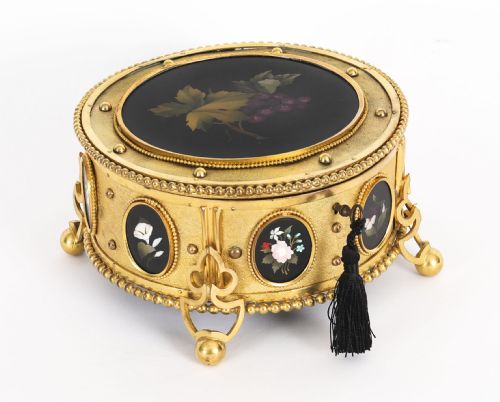
Regent Antiques has dated this Gilt Bronze Jewellery Casket to the 1870s.
C., on an oval panel surrounded by striking red guilloche enamel. This very fine casket is painted in enamel, and hails from the great centre of Enamel Art of Limoges in France, it is signed L.C. for Levy Coblentz, (1828-1900), he is known for his high quality work.

The casket with filigree textured panels is decorated with acanthus leaf mounts and raised on lion paw feet, the lid opens to reveal an interior lined with the original padded floral patterned silk, making it ideal for the storage and display of precious jewellery or small objects.

It is a lovely piece which is functional as well as being highly decorative.
Condition:
In excellent condition, the enamel in perfect condition.
Dimensions in cm:
Height 23 cm x Width 19 cm x Depth 9 cm
Dimensions in inches:

Height 9 inches x Width 7 inches x Depth 3 inches
Limoges enamel
has been produced at Limoges, in south-western France, over several centuries up to the present. There are two periods when it was of European importance. From the 12th century to 1370 there was a large industry producing metal objects decorated in enamel using the champlevé technique, of which most of the survivals (estimated at around 7,500 pieces), and probably most of the original production, are religious objects such as reliquaries.

After a gap of a century, the industry revived in the late 15th century, now specializing in the technique of painted enamel, and within a few decades making rather more secular than religious pieces. In the French Renaissance it was the leading centre, with several dynastic workshops, who often signed or punchmarked their work Luxury pieces such as plates, plaques and ewers were painted with sophisticated Mannerist decoration of pictorial figure scenes which on vessels were surrounded by elaborate borders.

In both periods the largest pieces include narrative scenes. These exemplify the styles of their respective periods. In the medieval champlevé the action is simply and directly shown by a few figures, with patterned backgrounds. In the Mannerist painted pieces numerous figures and detailed backgrounds tend to overwhelm the activity of the main figures.

After a decline from about 1630, and later competition from porcelain, high-quality production revived in the mid-19th century, and adopted art nouveau and other contemporary styles, with a relatively small production.

Limoges enamel has been produced at Limoges, in south-western France, over several centuries up to the present. There are two periods when it was of European importance. From the 12th century to 1370 there was a large industry producing metal objects decorated in enamel using the champlevé technique, of which most of the survivals (estimated at around 7,500 pieces), and probably most of the original production, are religious objects such as reliquaries.

After a gap of a century, the industry revived in the late 15th century, now specializing in the technique of painted enamel, and within a few decades making rather more secular than religious pieces. In the French Renaissance it was the leading centre, with several dynastic workshops, who often signed or punchmarked their work Luxury pieces such as plates, plaques and ewers were painted with sophisticated Mannerist decoration of pictorial figure scenes which on vessels were surrounded by elaborate borders.

In both periods the largest pieces include narrative scenes. These exemplify the styles of their respective periods. In the medieval champlevé the action is simply and directly shown by a few figures, with patterned backgrounds. In the Mannerist painted pieces numerous figures a
Regent Antiques has dated this Gilt Bronze Jewellery Casket to the 1870s.
We specialise in english and continental furniture, silver, porcelain and decorative items.
You can view the stock and full dealer information on the Regent Antiques Profile Page
Regent Antiques is a registered member of LAPADA CINOA

Antique Gilt Bronze Jewellery Casket & Limoges Miniature C.1870 19th Century