
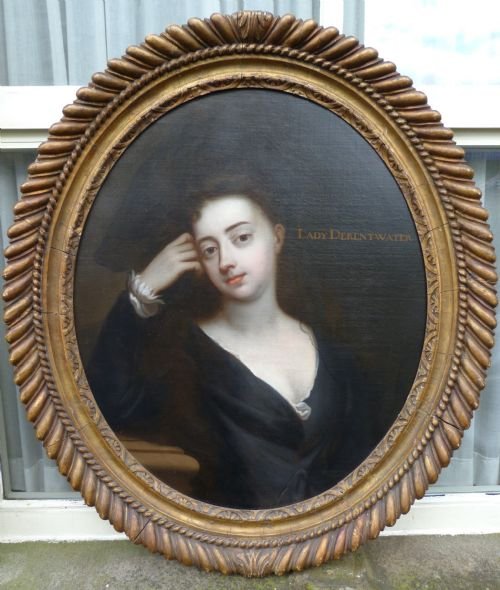
This portrait is typical of Dahl’s eloquent depiction of aristocratic women.
The sitter rests her elbow on a stone plinth and supports her head with her hand,the drapery and sitter’s turned head impart a subtle sense of movement, which, combined with the relaxed, even wistful pose helps convey a feeling of tranquillity.
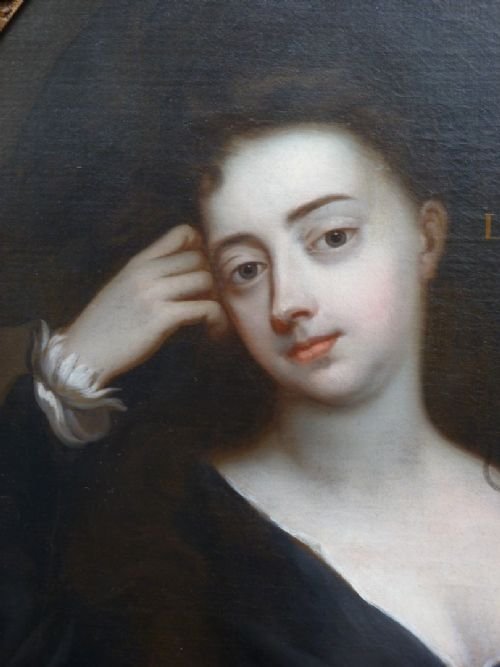
The veil on Lady Mary's head is a feature often used by Dahl, e.g. his portraits of the Duchess of Ormonde, Elizabeth Felton, Lady Hervey and the Countess of Clarendon.
MARY, COUNTESS OF DERWENTWATER (1673 - 1726) was the illegitimate daughter of Charles II of England by his mistress, the actress and singer Mary 'Moll' Davis, a celebrated rival of Nell Gwynn, King Charles' London-born mistress who was also an actress. She was given the title of Lady Mary Tudor.
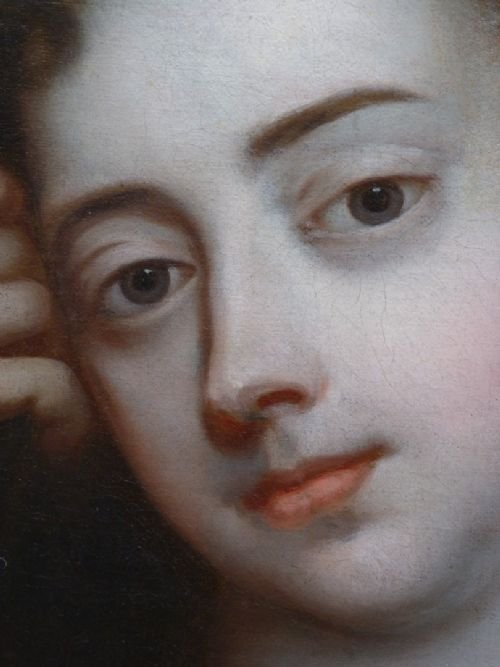
In the 'Masque for the Entertainment of the King', John Blow's opera 'Venus and Adonis' of 1680, Moll created the role of Venus, while her daughter, Lady Mary, sang Cupid. This was the first English opera.
Charles gave his daughter an annuity of £1500 in September 1683, and she was married to Edward, Viscount Radcliffe, later Earl of Derwentwater, in August 1687.
This prestigious marriage alliance with the ill-fated Stuarts proced to be the downfall of the Radcliffes, who, after the Glorious Revolution, were noted as the most wealthy and powerful Jacobite family in the North of England.
Two of Mary's three sons were to be executed for their parts in the Jacobite risings of 1715 and 1745. James, who died in 1716, was described as being an accomplished singer and guitarist, so perhaps he inherited this from his mother and grandmother...who appears in Lely's portrait of c.1674 playing a guitar.
After the Earl's death on 29 April 1705, Mary married Henry Graham (d. 7 January 1707) on 23 May 1705. After Henry's death she married Major James Rooke (d. 16 June 1773) on 26 August 1707.
She died in Paris on 5 November 1726, shortly after her fifty-third birthday.
MICHAEL DAHL (1659-1743) was born in Stockholm; after studying in Paris, Rome and Frankfurt he settled in London in 1689. He soon became the best patronised portrait painter in England after Kneller. He was much employed at the Court painting many portraits; a great patron of the 1690s was the Duke of Somerset, for whom he painted the series of portraits of Court ladies known as the 'Petworth Beauties'.
His style is extremely close to Kneller but his interpretation of character is less brash and more human. He has a quieter but somehow more understanding appeal to character which relies on its own integrity to make its impact; his works are of a real distinction.
This painting is typical of Dahl's sensitive portraiture and is of considerable charm.
SIZE: 38 x 33 inches inc. frame.
PROVENANCE:
For many years in the Collection of the Seymour family of Wiltshire.
Sold at Christie's c.1950 and bought by a Somerset family with Seymour connections.
In their possession for c.57 years.
Then another Somerset private collection.
VERSO: old label with information on the Derwentwaters and the inscription "From The Times Octbr 13 1874. C.H. Seymour"
Roy and nadine precious: specialists in portraiture from the 16th to the 20th century. Established in 1972.
You can view the stock and full dealer information on the Roy Precious - Antiques & Fine Art Profile Page
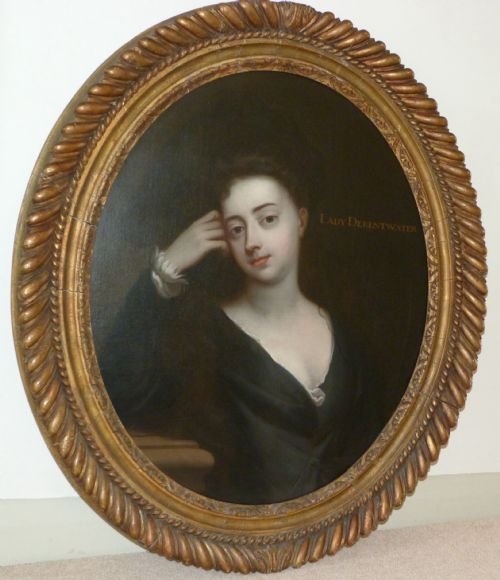
Sold....portrait of Lady Derwentwater, by Michael Dahl
