5,794  PAGES BROWSED TODAY PAGES TODAY 0  ANTIQUES UPLOADED TODAY NEW ARRIVALS
ID #SA1043105
FOR SALE
£6,500
Email
Save
Fine Two-day Marine Chronometer Signed Charles Frodsham
Alexander George Antiques Ltd.
for sale €7,605     $8,255
£6,500
Alexander George Antiques Ltd.

Alexander George Antiques Ltd.

Sellingantiques Verified Since Aug 2019
View Dealers Stock Page
  • About Us
    Offering carefully selected antique masterpieces from the 17th & 18th centuries
  • Trade Associations
    Alexander George Antiques Ltd. is a registered member of LAPADA 
Id #SA1043105
PDF SHARE
SAVE

Fine Two-day Marine Chronometer Signed Charles Frodsham

19th century
Description

A Sturdy English Two-Day Marine Chronometer Made by the Renowned Maker Charles Frodsham, c. 1860

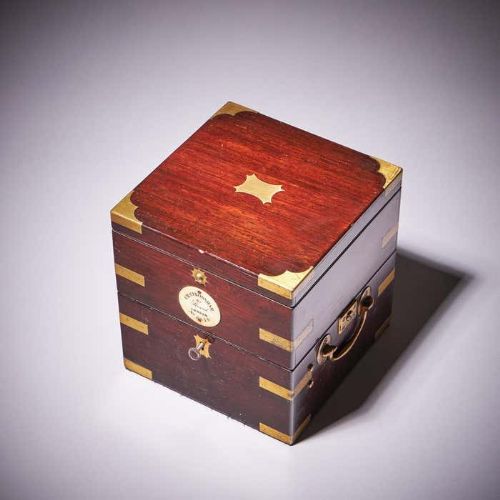
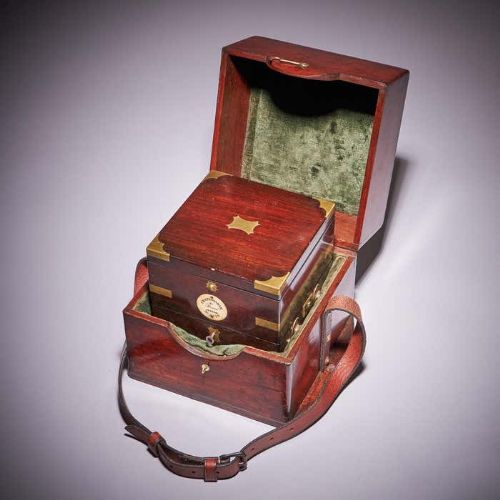
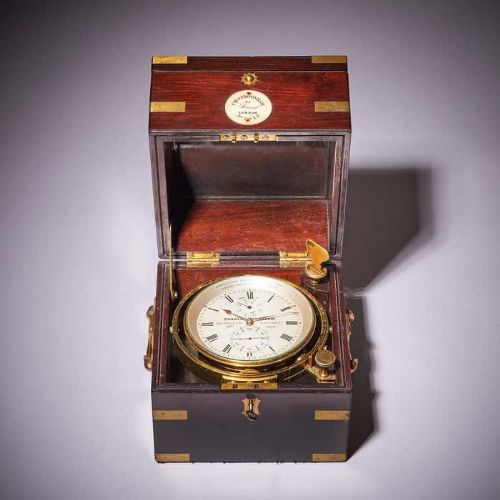
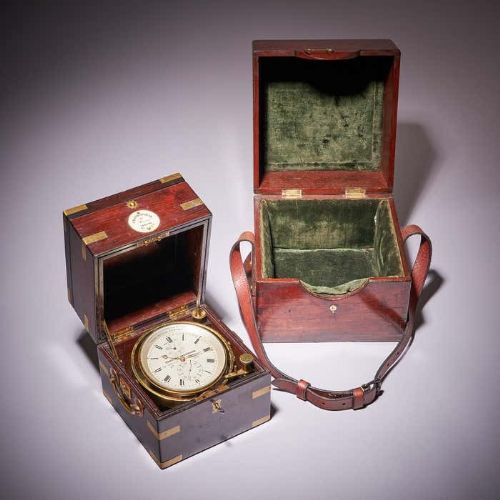
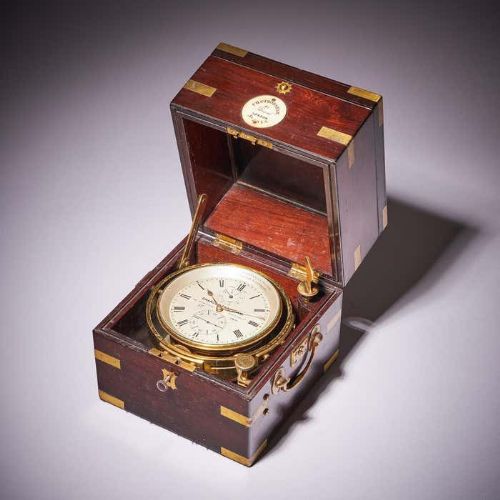
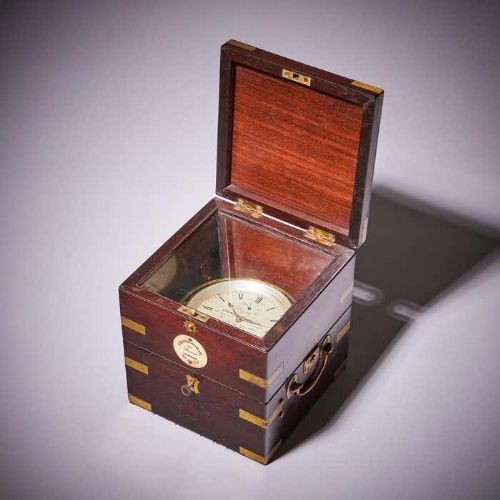
A classic expertly produced 19th century English chronometer in a three-tier rosewood case, made c. 1860. The typically brass bound case consists of a lower and a glazed upper part, as well as a top lid. The lower part has two drop handles to the sides, while the front has a lock and key with an inlaid brass escutcheon. In the front of the upper part is a brass button to lock the top lid, as well as a circular bone plaque inscribed as follows: CHAs FRODSHAM 84 Strand LONDON No 2819. The movement is situated in a gimballed brass bowl, which can be secured for transport purposes by a turnable handle in the bottom right corner of the case. The 4" silvered dial is protected by a flat bevelled glass set in a brass bezel, screwed to the bowl. The top rim of the silvered inside of the bezel bears the following text ‘EXPOSITION UNIVERSELLE DE 1855 GRANDE MEDAILLE D’HONNEUR’. In addition, there is an original protective case, in which the chronometer can be placed to protect it from external hazards.
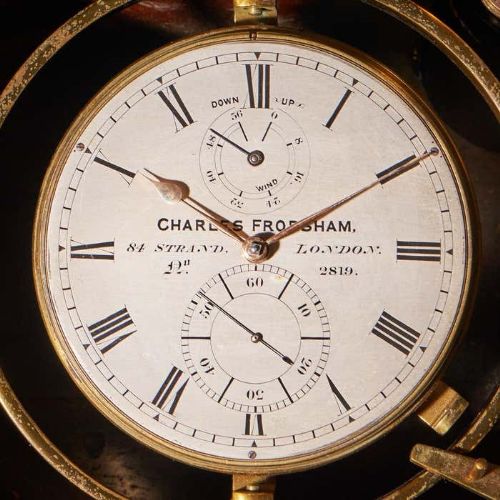
The maker has signed and numbered the chronometer on the silvered dial in the following manner:

CARLES FRODSHAM

84 STRAND LONDON

No 2819

The time is indicated by a fine pair of gilt brass hands on the silvered dial with a Roman chaptering, five-minute and minute divisions.
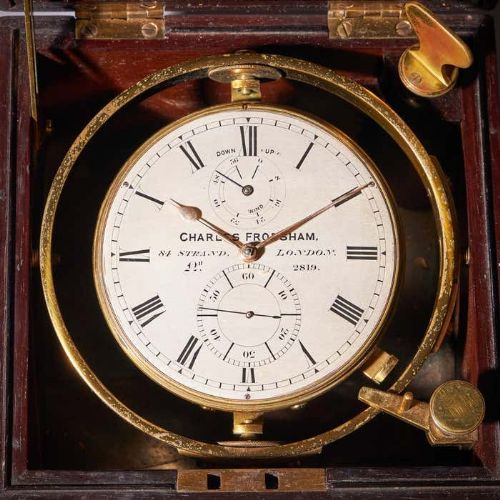
The seconds are indicated by a blued-steel hand on a separate chapter ring below the middle with Arabic ten-second, five-second and second divisions. Below the XII is up-and-down dial 0-56 (hours), indicating the state of winding.
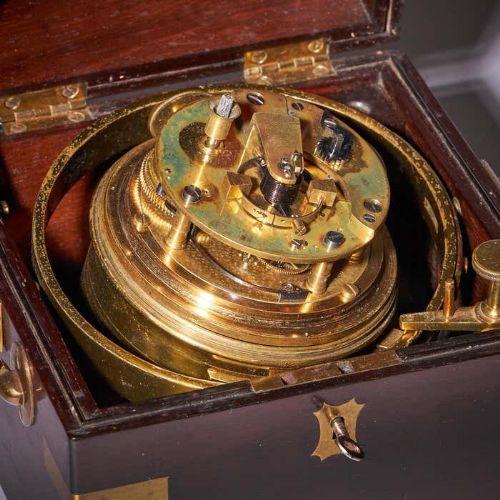
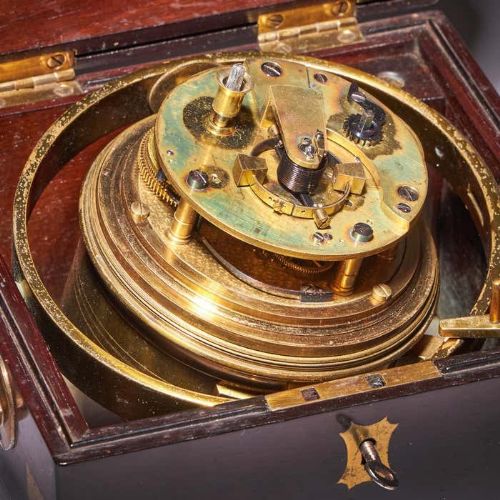
The two-day movement is constructed between two circular plates and is driven by a spring in a spring barrel via a chain fusee. It has an Earnshaw spring detent escapement with a compensated balance and helical spring. The chronometer is wound by a special key with a ratchet to prevent winding the clock in the wrong direction. The original key can be stored in a hole in the top right corner of the case. The winding hole is covered by a large circular sprung shutter.
Dimensions: 18x17.5x18.5cm

The maker:

Charles Frodsham was born into a dynasty of clock, watch and chronometer makers on the 15 April 1810. His father William James Frodsham (1779-1850) and Hannah Lambert had ten children, five of whom were apprenticed to their father and later became horologists in their own right.
Charles was educated at Christ’s Hospital, the Bluecoat School in Newgate, London, and as a condition of the Foundation, was apprenticed at the age of fourteen to his father William. He showed early promise submitting two chronometers (numbers 1 & 2) to the 1830 Premium Trials at Greenwich, No.2 gaining the second Premium prize of £170. A further nine chronometers were then entered for trial in subsequent years, until the termination of the Premium Trials, in 1836.
By the mid-1850s Charles had established himself as one of the period’s most eminent horologists. In 1854 upon the death of Benjamin Lewis Vulliamy, he purchased the goodwill of the business and succeeded Vulliamy as Superintendent and Keeper of Her Majesty’s Clocks at Buckingham Palace. This prestigious title aided the sale of clocks, watches and chronometers worldwide, Charles having overseas representation and agents in America, France and Spain. He was a liberal supporter and judicial advisor to the societies connected with horology, being one of the founding members, and later Vice President, of the British Horological Institute in 1858, and a Liveryman of the Worshipful Company of Clockmakers, in which he served as Master in 1855 and 1862.
In the same year the Great International Exhibition was held at South Kensington, where Charles not only exhibited but was also one of the jurors. Amongst his exhibits were a month duration marine chronometer.

Charles died on the 11 Januar

Physical Dimensions
Height
18.5cm (7.28")
Width
17.7cm (6.97")
Depth
18cm (7.09")
Declaration

Alexander George Antiques Ltd. has dated this Antique Marine Chronometer Clock to the 19th Century.

Reference Numbers
Sellingantiques Reference
SA1043105
Dealers Notes

Whether you are a collector or a first-time buyer the choice of pieces will inspire. Each has been carefully selected for its exceptional design and provenance, as well as in many instances its academic significance.

Originality and authenticity are paramount; and using our extensive knowledge and experience in furniture conservation and restoration we can ensure that our clients can buy with absolute confidence.

Description
A Sturdy English Two-Day Marine Chronometer Made by the Renowned Maker Charles Frodsham, c. 1860

A classic expertly produced 19th century English chronometer in a three-tier rosewood case, made c. 1860. The typically brass bound case consists of a lower and a glazed upper part, as well as a top lid.

The lower part has two drop handles to the sides, while the front has a lock and key with an inlaid brass escutcheon.
Alexander George Antiques Ltd.

In the front of the upper part is a brass button to lock the top lid, as well as a circular bone plaque inscribed as follows: CHAs FRODSHAM 84 Strand LONDON No 2819. The movement is situated in a gimballed brass bowl, which can be secured for transport purposes by a turnable handle in the bottom right corner of the case. The 4" silvered dial is protected by a flat bevelled glass set in a brass bezel, screwed to the bowl. The top rim of the silvered inside of the bezel bears the following text ‘EXPOSITION UNIVERSELLE DE 1855 GRANDE MEDAILLE D’HONNEUR’. In addition, there is an original protective case, in which the chronometer can be placed to protect it from external hazards.

fig 1. A Victorian two-day marine chronometer by Charles Frodsham set in a brass-bound mahogany box beside its velvet-lined outer carrying case with leather strap.
fig 1. Fine Two-day Marine Chronometer Signed Charles Frodsham

The maker has signed and numbered the chronometer on the silvered dial in the following manner:

CARLES FRODSHAM

84 STRAND LONDON

No 2819

The time is indicated by a fine pair of gilt brass hands on the silvered dial with a Roman chaptering, five-minute and minute divisions.

fig 2. A Victorian two-day marine chronometer by Charles Frodsham set in a brass-bound mahogany box beside its velvet-lined outer carrying case with leather strap.
fig 2. Fine Two-day Marine Chronometer Signed Charles Frodsham

The seconds are indicated by a blued-steel hand on a separate chapter ring below the middle with Arabic ten-second, five-second and second divisions. Below the XII is up-and-down dial 0-56 (hours), indicating the state of winding.

fig 3. A Victorian two-day marine chronometer by Charles Frodsham set in a brass-bound mahogany box beside its velvet-lined outer carrying case with leather strap.
fig 3. Fine Two-day Marine Chronometer Signed Charles Frodsham

The two-day movement is constructed between two circular plates and is driven by a spring in a spring barrel via a chain fusee. It has an Earnshaw spring detent escapement with a compensated balance and helical spring. The chronometer is wound by a special key with a ratchet to prevent winding the clock in the wrong direction. The original key can be stored in a hole in the top right corner of the case. The winding hole is covered by a large circular sprung shutter.

fig 4. A Victorian two-day marine chronometer by Charles Frodsham set in a brass-bound mahogany box beside its velvet-lined outer carrying case with leather strap.
fig 4. Fine Two-day Marine Chronometer Signed Charles Frodsham

Dimensions: 18x17.5x18.5cm

The maker:

Charles Frodsham was born into a dynasty of clock, watch and chronometer makers on the 15 April 1810. His father William James Frodsham (1779-1850) and Hannah Lambert had ten children, five of whom were apprenticed to their father and later became horologists in their own right.

fig 5. A Victorian two-day marine chronometer by Charles Frodsham set in a brass-bound mahogany box beside its velvet-lined outer carrying case with leather strap.
fig 5. Fine Two-day Marine Chronometer Signed Charles Frodsham

Charles was educated at Christ’s Hospital, the Bluecoat School in Newgate, London, and as a condition of the Foundation, was apprenticed at the age of fourteen to his father William. He showed early promise submitting two chronometers (numbers 1 & 2) to the 1830 Premium Trials at Greenwich, No.2 gaining the second Premium prize of £170. A further nine chronometers were then entered for trial in subsequent years, until the termination of the Premium Trials, in 1836.

fig 6. A Victorian two-day marine chronometer by Charles Frodsham set in a brass-bound mahogany box beside its velvet-lined outer carrying case with leather strap.
fig 6. Fine Two-day Marine Chronometer Signed Charles Frodsham

By the mid-1850s Charles had established himself as one of the period’s most eminent horologists. In 1854 upon the death of Benjamin Lewis Vulliamy, he purchased the goodwill of the business and succeeded Vulliamy as Superintendent and Keeper of Her Majesty’s Clocks at Buckingham Palace. This prestigious title aided the sale of clocks, watches and chronometers worldwide, Charles having overseas representation and agents in America, France and Spain. He was a liberal supporter and judicial advisor to the societies connected with horology, being one of the founding members, and later Vice President, of the British Horological Institute in 1858, and a Liveryman of the Worshipful Company of Clockmakers, in which he served as Master in 1855 and 1862.

fig 7. A Victorian two-day marine chronometer by Charles Frodsham set in a brass-bound mahogany box beside its velvet-lined outer carrying case with leather strap.
fig 7. Fine Two-day Marine Chronometer Signed Charles Frodsham

In the same year the Great International Exhibition was held at South Kensington, where Charles not only exhibited but was also one of the jurors. Amongst his exhibits were a month duration marine chronometer.

Charles died on the 11 Januar

Height
18.5cm (7.28")
Width
17.7cm (6.97")
Depth
18cm (7.09")
Date of Manufacture

Alexander George Antiques Ltd. has dated this Antique Marine Chronometer Clock to the 19th Century.

Reference Numbers
Sellingantiques Ref
SA1043105
Alexander George Antiques Ltd.
Sellingantiques verified Since Aug 2019

Offering carefully selected antique masterpieces from the 17th & 18th centuries

Dealer Profile

You can view the stock and full dealer information on the Alexander George Antiques Ltd. Profile Page

Trade Associations

Alexander George Antiques Ltd. is a registered member of LAPADA 

PDF SHARE
SAVE
A Victorian two-day marine chronometer by Charles Frodsham set in a brass-bound mahogany box beside its velvet-lined outer carrying case with leather strap.
1 / 12
Archive I A Victorian two-day marine chronometer by Charles Frodsham set in a brass-bound mahogany box beside its velvet-lined outer carrying case with leather strap.

Fine Two-Day Marine Chronometer Signed Charles Frodsham
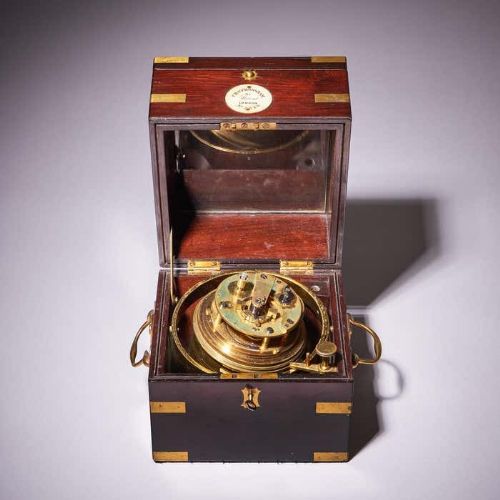
Archive II A Victorian two-day marine chronometer by Charles Frodsham set in a brass-bound mahogany box beside its velvet-lined outer carrying case with leather strap. View II
Archive III A Victorian two-day marine chronometer by Charles Frodsham set in a brass-bound mahogany box beside its velvet-lined outer carrying case with leather strap. View III
Archive IV A Victorian two-day marine chronometer by Charles Frodsham set in a brass-bound mahogany box beside its velvet-lined outer carrying case with leather strap. View IV
Archive V A Victorian two-day marine chronometer by Charles Frodsham set in a brass-bound mahogany box beside its velvet-lined outer carrying case with leather strap. View V
Archive VI A Victorian two-day marine chronometer by Charles Frodsham set in a brass-bound mahogany box beside its velvet-lined outer carrying case with leather strap. View VI
Archive VII A Victorian two-day marine chronometer by Charles Frodsham set in a brass-bound mahogany box beside its velvet-lined outer carrying case with leather strap. View VII
Archive VIII A Victorian two-day marine chronometer by Charles Frodsham set in a brass-bound mahogany box beside its velvet-lined outer carrying case with leather strap. View VIII
Archive IX A Victorian two-day marine chronometer by Charles Frodsham set in a brass-bound mahogany box beside its velvet-lined outer carrying case with leather strap. View IX
Archive X A Victorian two-day marine chronometer by Charles Frodsham set in a brass-bound mahogany box beside its velvet-lined outer carrying case with leather strap. View X
Archive XI A Victorian two-day marine chronometer by Charles Frodsham set in a brass-bound mahogany box beside its velvet-lined outer carrying case with leather strap. View XI
Archive XII A Victorian two-day marine chronometer by Charles Frodsham set in a brass-bound mahogany box beside its velvet-lined outer carrying case with leather strap. View XII
Enlarged Archival View
Telephone 07787 536199
Location
Buscot Manor
Buscot
Oxfordshire
SN7 8DA
United Kingdom

By appointment only.
Verified Since Aug 2019
Items For Sale 93
Items Sold 231
Alexander George Antiques Ltd.
Verified Since Aug 2019
View Dealer Info
Location: Buscot Manor, Buscot, Oxfordshire, SN7 8DA, United Kingdom, , By appointment only.
Verified
Aug 2019
For Sale
93
Sold
231
A Victorian two-day marine chronometer by Charles Frodsham set in a brass-bound mahogany box beside its velvet-lined outer carrying case with leather strap.
Fine Two-Day Marine Chronometer Signed Charles Frodsham
Ref: SA1043105
A Victorian two-day marine chronometer by Charles Frodsham set in a brass-bound mahogany box beside its velvet-lined outer carrying case with leather strap.
Detail View 1
Detail View 2
Detail View 3
Detail View 4
Detail View 5
Detail View 6
Detail View 7
Detail View 8
Detail View 9
Detail View 10
Detail View 11
Archival Detail
Every single antique dealer on our platform is individually approved by our internal team. We verify their professional trade history, ethical standards, and photographic quality to ensure a secure, high-standard buying environment. Upon joining, every dealer agrees to a strict 9-point code of conduct. While issues can occasionally arise, our dealers typically resolve them swiftly and directly with the buyer. In fact, since our founding in 2002, Sellingantiques has only had to step in to help resolve an issue on roughly five occasions—a true testament to the quality of our dealers and their dedication to your happiness.
Our dealers are highly experienced in packing and shipping fragile, high-value antiques. Because you are in direct contact with the dealer, you will be able to easily go through all available shipping and insurance options together to ensure your item arrives safely.
Antiques are the ultimate green purchase. By choosing historical pieces over newly manufactured goods, you completely eliminate the carbon footprint of modern mass production while preserving exceptional, timeless craftsmanship.

Marine chronometers were developed in the eighteenth and nineteenth centuries as precise timekeeping instruments used at sea to determine a ships longitude by accurately maintaining Greenwich Mean Time.

These instruments feature precision brass movements suspended within gimballed brass rings, housed inside three-tier brass-bound mahogany or rosewood boxes with velvet-lined protective outer transport cases.

Authentic period examples feature silvered dials signed by documented horologists, individual movement serial numbers, functional brass gimbals, and original brass-bound wooden cabinetry.

Position the instrument on an executive office desk, sideboard, or library bookshelf, allowing its brass hardware and rich wood grain to serve as an architectural accent piece.

Keep the casing in a climate-controlled environment away from direct sunlight, dust with a soft microfibre cloth, and have the mechanical movement serviced regularly by a specialist horologist.
items
Add keywords to the filter
Price
£100
£250000
Era
Movements
Material
Origin
Stock Location
Freshness
Online Payments
Categories