14,354  PAGES BROWSED TODAY PAGES TODAY 36  ANTIQUES UPLOADED TODAY NEW ARRIVALS
ID #SA1037876
SOLD
Email
Save
A Beautiful Double Six Grande Sonnerie Longcase Clock – Joseph Knibb - London
The Antique Clock Co.
sold SA1037876
Sorry, but this item has been sold.
The Antique Clock Co.

The Antique Clock Co.

Sellingantiques Verified Since Apr 2021
View Dealers Stock Page
Id #SA1037876
PDF SHARE
SAVE

A Beautiful Double Six Grande Sonnerie Longcase Clock – Joseph Knibb - London

17th century
Description

This particular method of Grande Sonnerie striking, which has been used on this clock, is ingenious and probably the most complex employed by Knibb. To reduce the number of blows of the hammer, and thus the power required to a minimum, double six-hour striking is employed - (in this method, normal striking was employed from 1 to 6 and then repeated again from 7 to 12, thus saving 36 strikes in a 12 hour period). This reduces the number of blows powered by one train for the hours at the quarters from 3714 to 2016 over eight days. The other train provides the power for the quarters and the full hour striking, which involves 2400 blows every eight days.
Movement:

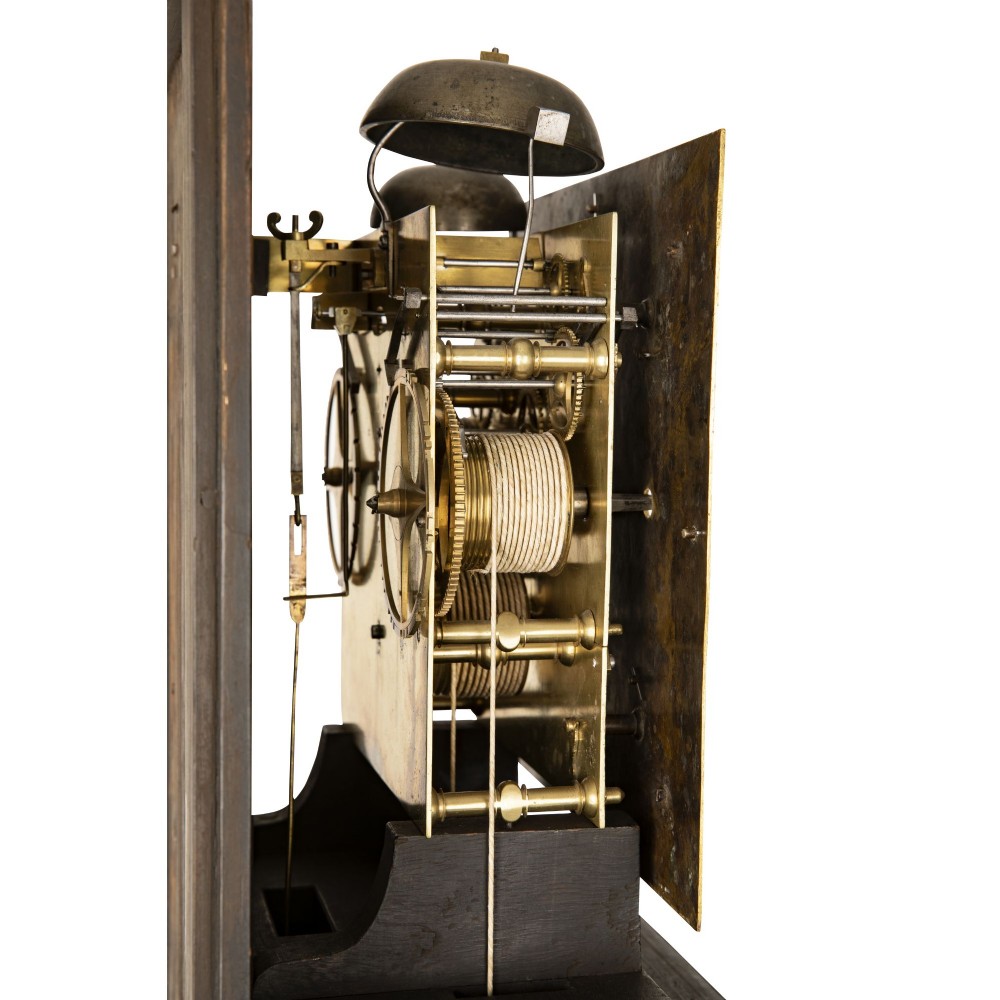
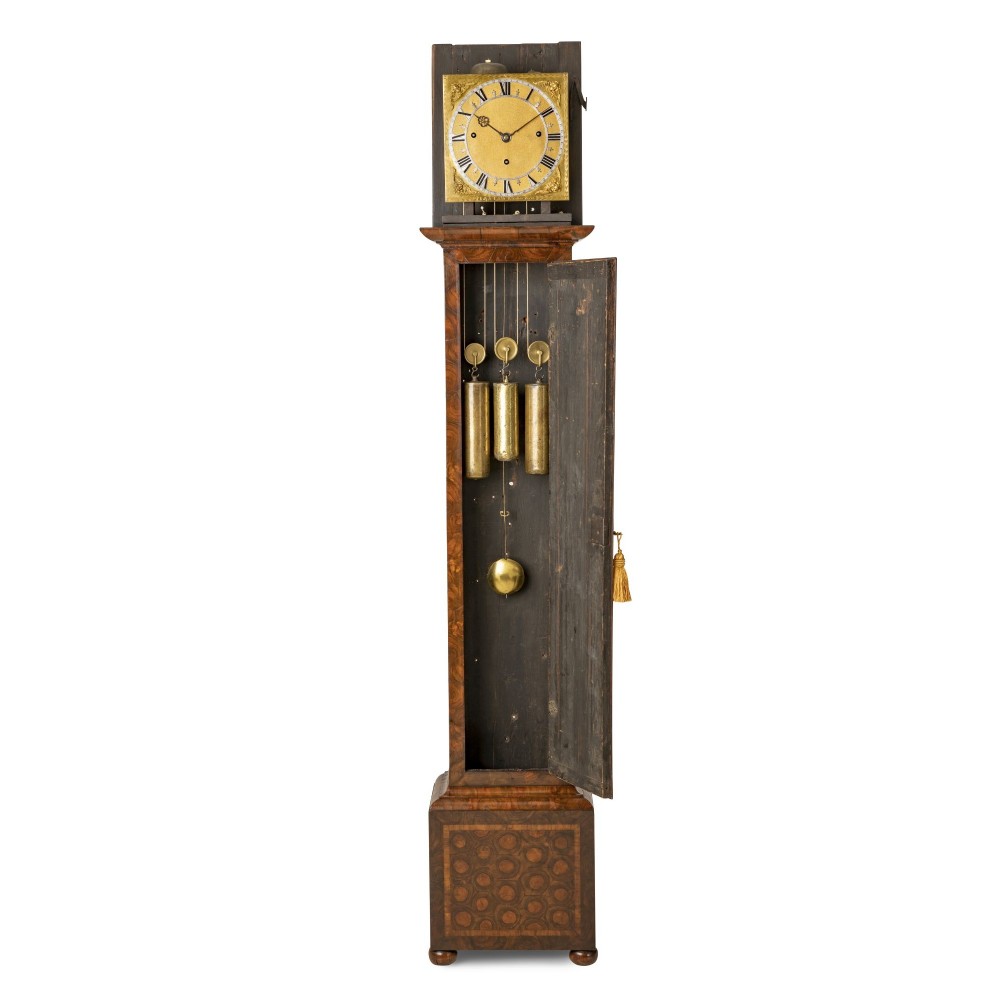
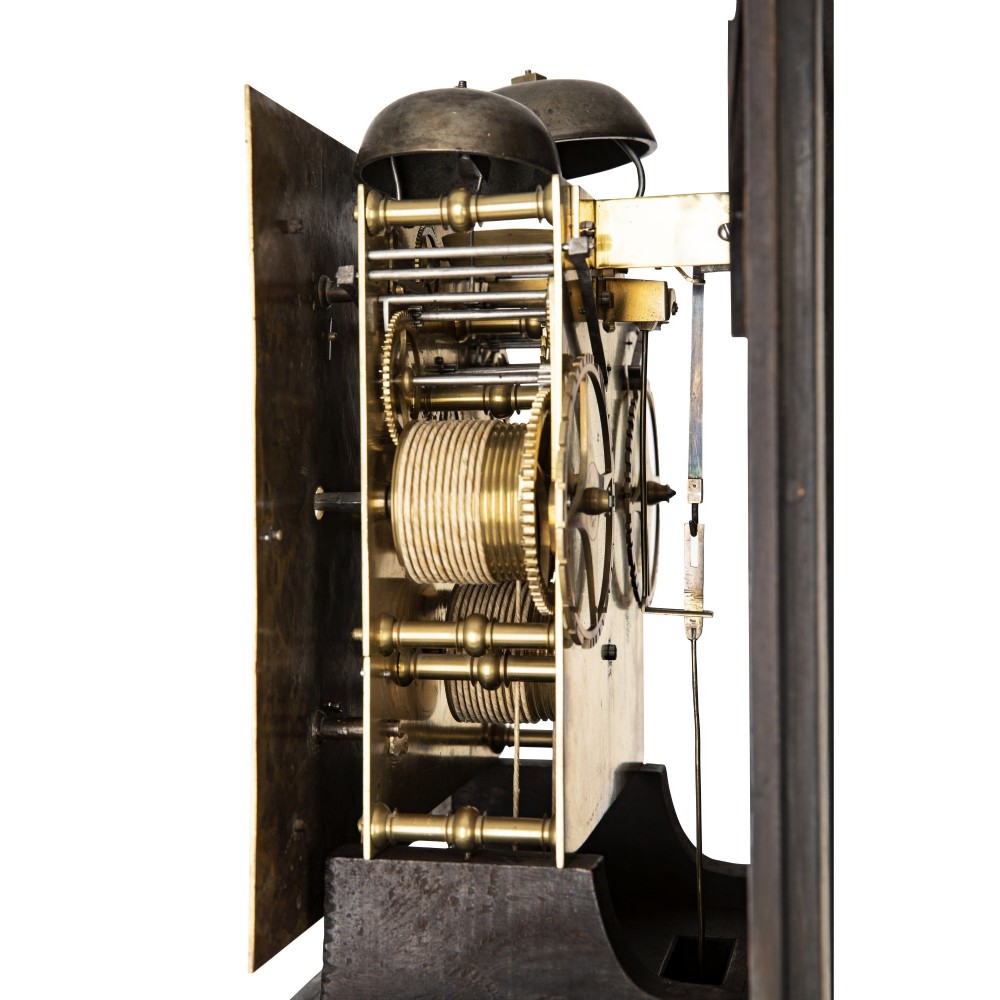
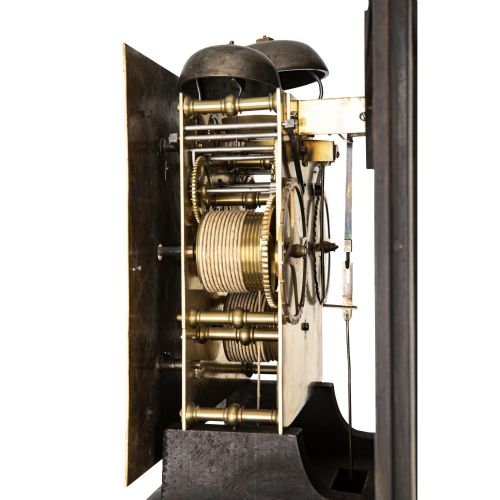
The beautifully conceived movement has ten latched pillars, a front plate split into three for ease of assembly, external count wheels for the hours and quarters and an anchor escapement. A large and a small bell are provided. The pendulum, with a brass rod and threaded bob, has a butterfly nut above the back-cock for regulation. A bracket (re-instated) fixes the movement to the case.
Dial:

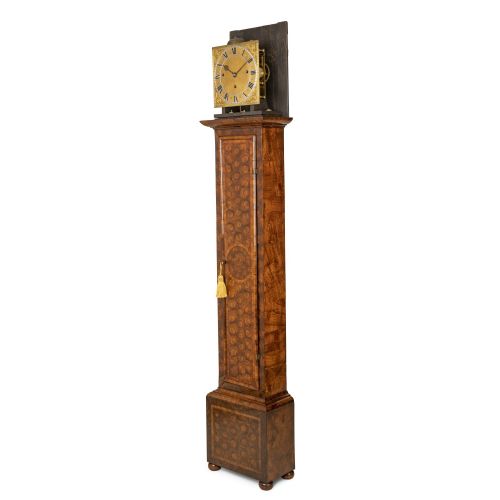
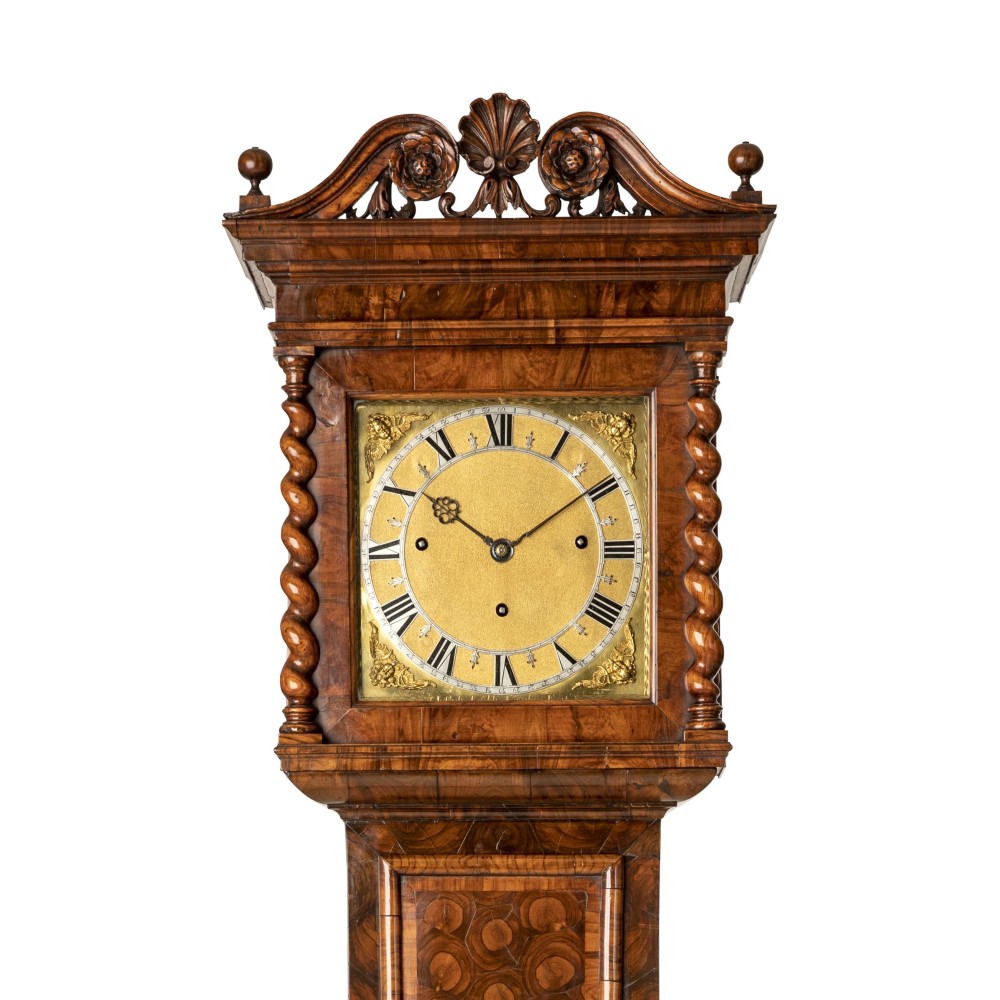
The 10” dial, which is signed along the bottom edge 'Joseph Knibb Londini Fecit', has wheatear engraving to its border, cherub spandrels and latched feet. The finely skeletonised chapter ring has quarter and half-hour marks with every minute numbered.
Case:

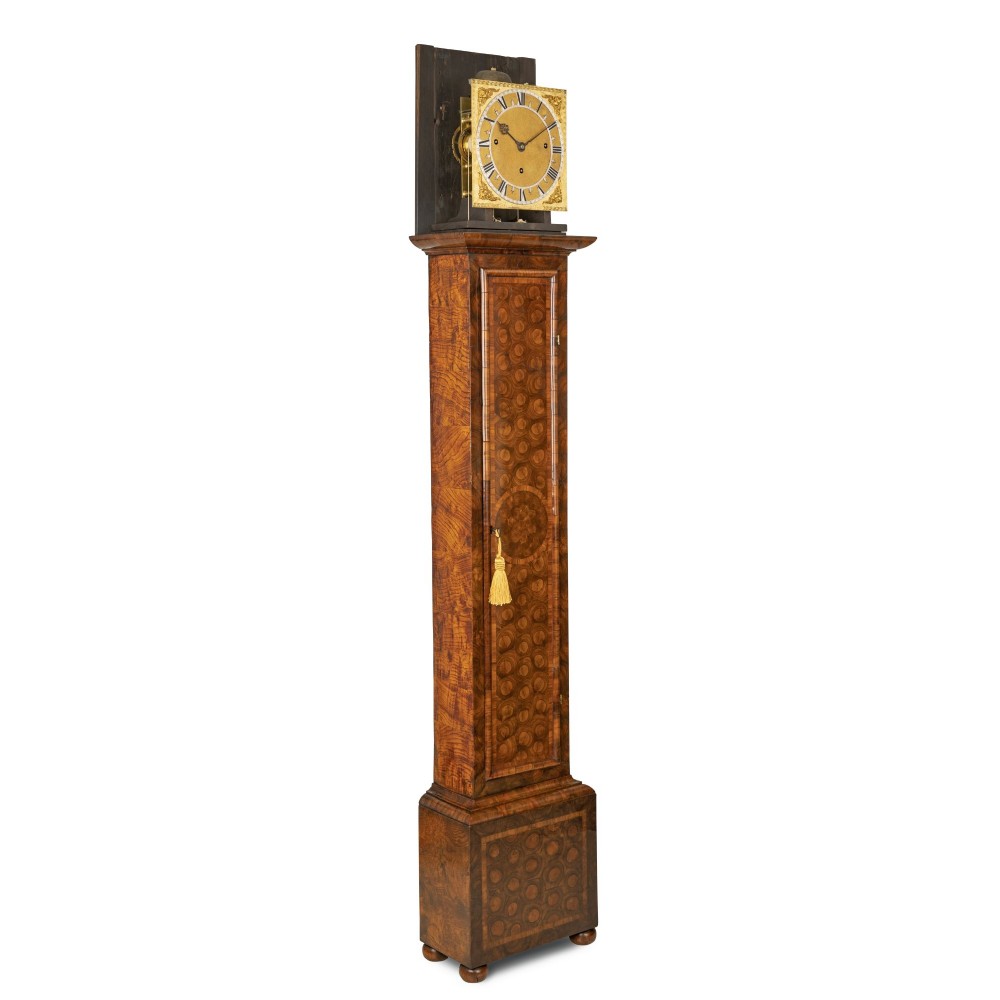
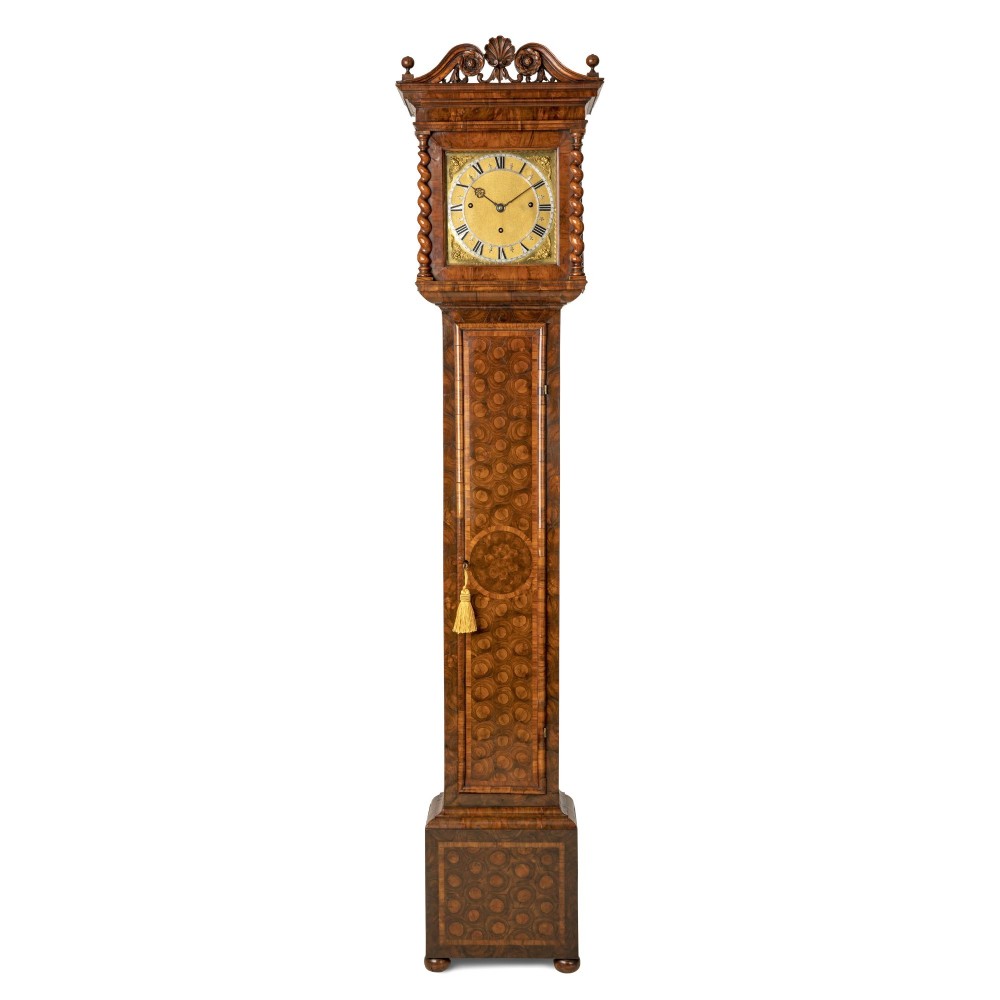
The case, the proportions of which are typical of Knibb at this period, is surmounted by a carved cresting with a shell motif to the centre, which is unusually mounted separately, which makes one wonder if originally a crest was fitted there. Spiral twist columns are employed, and there is a convex mould beneath the hood, which lifts up.
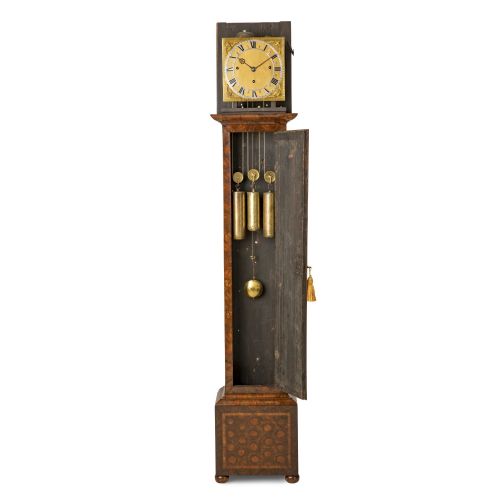
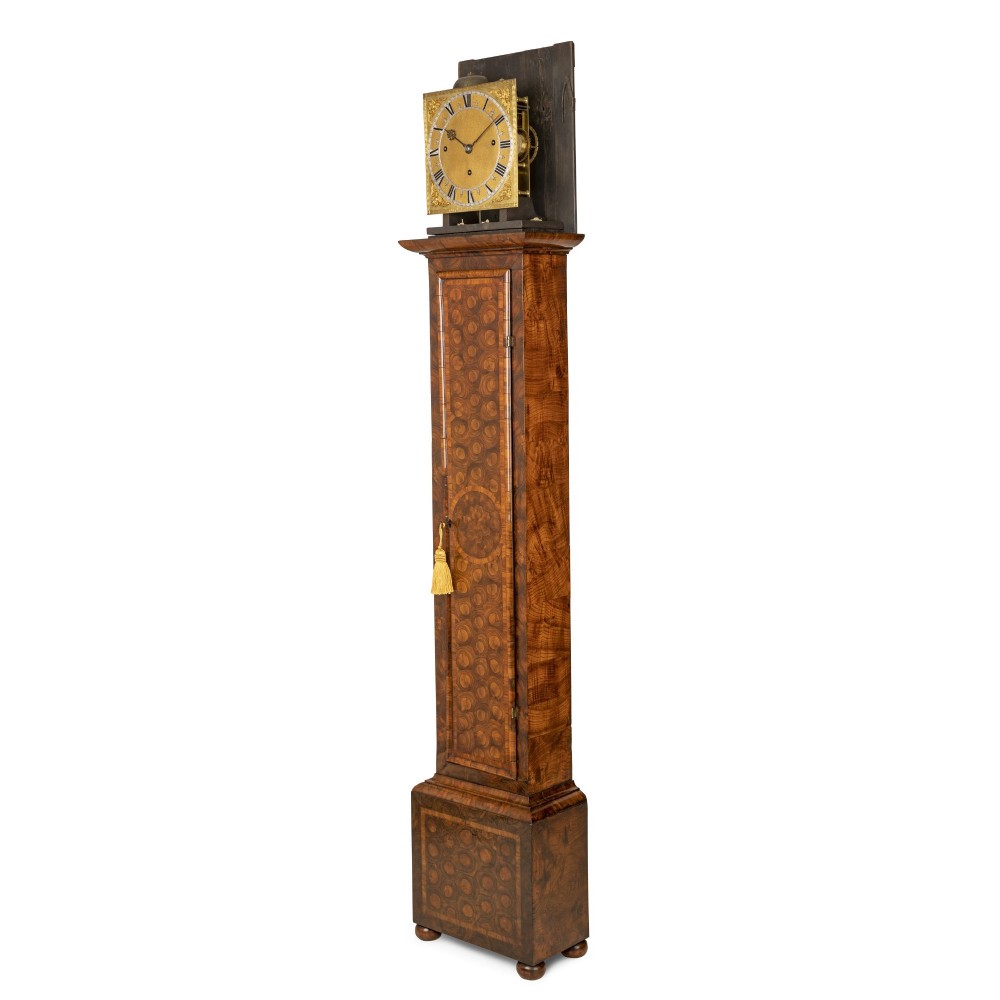
The trunk door, which is surrounded by a half-round mould, is decorated with olive-wood oyster veneers. To the centre is a cross-banded ring, within which are small pieces of olive wood.

Joseph Knibb – B.1640 – D.1711
Joseph Knibb was one of the most celebrated clockmakers of his day and was highly admired by Charles II, for whom he made several fine clocks.

Joseph was apprentice to his cousin Samuel Knibb in 1655 at Newport Pagnell, and after his seven-year apprenticeship, he then moved to Oxford in 1662, whilst Samuel moved to London the same year. It was far from an easy move, when he arrived in the city he was thought of as a foreigner by the freeman traders of the city who objected to his presence. It is thought that he traded without permission until, upon payment of a fine in 1668, he was then free to carry out his business without hindrance. It was at this time he was most interested in the development of the anchor escapement and seconds pendulum for timekeeping accuracy – of which this particular clock is a fine example of his efforts.
In 1670 he moved to London, this could have been because of his accurate clocks or it could possibly be to do with Samuels death. Either way, immediately after setting up business in the city, he was granted the freedom of the Clockmakers’ Company. He was quick to become established in London with a very distinctive style along with several notable inventions. Apart from producing consistently high-quality work, Joseph was imaginative, inventive and had an excellent eye for proportion. He had many apprentices and was elected as Steward of the Clockmakers’ Company in August 1984 and then Assistant in 1689.

By the time he retired in 1697, his business is believed to have made over four hundred clocks, proving that he was an illustrious businessman during his time in London. He retired to Hanslop, where he still made clocks, only not on such a large scale. He died in December 1711.

Comparative Literature: The Knibb Family Clockmakers by R. A. Lee

Serviced and guaranteed for 3 years.

Height: 83? or 211 cm (Including crest)

Width: 17 ½" or 44 cm

Depth: 10" or 25 cm

CIRCA. 1675

Provenance: Private collection – Private collection, UK

The clock was formerly in the collection of Viscount Hereford.

Would you lik

Physical Dimensions
Height
211cm (83.07")
Width
44cm (17.32")
Depth
25cm (9.84")
Declaration

The Antique Clock Co. has dated this piece to the 17th Century.

Reference Numbers
Sellingantiques Reference
SA1037876
Description
This particular method of Grande Sonnerie striking, which has been used on this clock, is ingenious and probably the most complex employed by Knibb. To reduce the number of blows of the hammer, and thus the power required to a minimum, double six-hour striking is employed - (in this method, normal striking was employed from 1 to 6 and then repeated again from 7 to 12, thus saving 36 strikes in a 12 hour period).
This reduces the number of blows powered by one train for the hours at the quarters from 3714 to 2016 over eight days.
The Antique Clock Co.

The other train provides the power for the quarters and the full hour striking, which involves 2400 blows every eight days.

fig 1. A BEAUTIFUL DOUBLE SIX GRANDE SONNERIE LONGCASE CLOCK – JOSEPH KNIBB - LONDON
fig 1. A Beautiful Double Six Grande Sonnerie Longcase Clock – Joseph Knibb - London

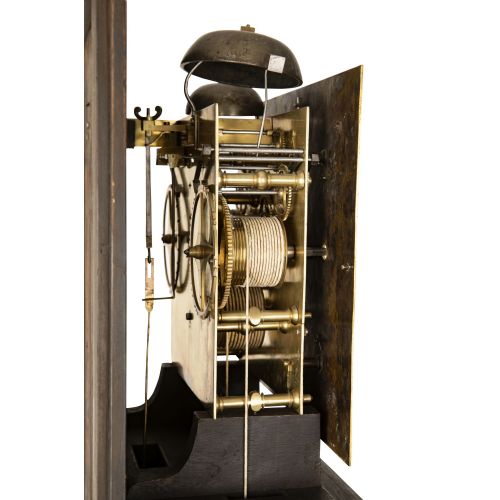
Movement:

The beautifully conceived movement has ten latched pillars, a front plate split into three for ease of assembly, external count wheels for the hours and quarters and an anchor escapement. A large and a small bell are provided. The pendulum, with a brass rod and threaded bob, has a butterfly nut above the back-cock for regulation. A bracket (re-instated) fixes the movement to the case.

fig 2. A BEAUTIFUL DOUBLE SIX GRANDE SONNERIE LONGCASE CLOCK – JOSEPH KNIBB - LONDON
fig 2. A Beautiful Double Six Grande Sonnerie Longcase Clock – Joseph Knibb - London

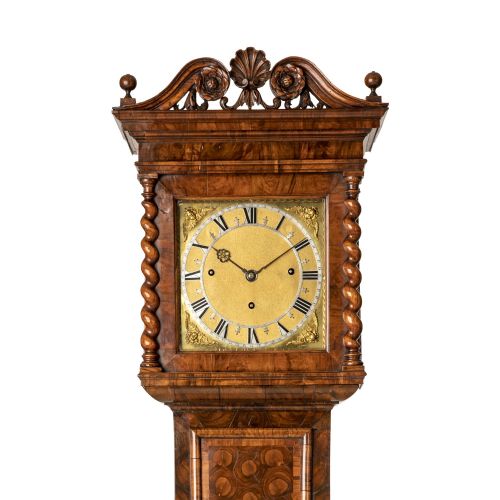
Dial:

The 10” dial, which is signed along the bottom edge 'Joseph Knibb Londini Fecit', has wheatear engraving to its border, cherub spandrels and latched feet. The finely skeletonised chapter ring has quarter and half-hour marks with every minute numbered.

fig 3. A BEAUTIFUL DOUBLE SIX GRANDE SONNERIE LONGCASE CLOCK – JOSEPH KNIBB - LONDON
fig 3. A Beautiful Double Six Grande Sonnerie Longcase Clock – Joseph Knibb - London

Case:

The case, the proportions of which are typical of Knibb at this period, is surmounted by a carved cresting with a shell motif to the centre, which is unusually mounted separately, which makes one wonder if originally a crest was fitted there. Spiral twist columns are employed, and there is a convex mould beneath the hood, which lifts up.

fig 4. A BEAUTIFUL DOUBLE SIX GRANDE SONNERIE LONGCASE CLOCK – JOSEPH KNIBB - LONDON
fig 4. A Beautiful Double Six Grande Sonnerie Longcase Clock – Joseph Knibb - London

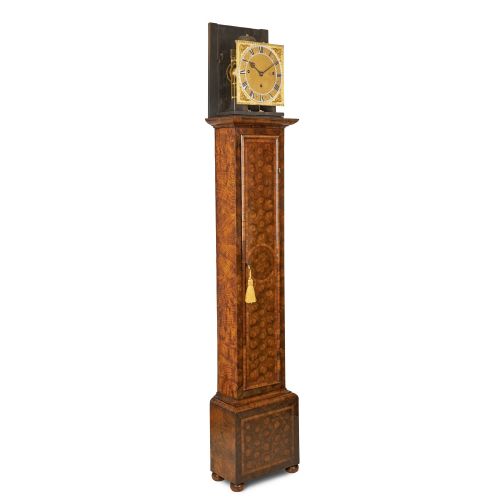
The trunk door, which is surrounded by a half-round mould, is decorated with olive-wood oyster veneers. To the centre is a cross-banded ring, within which are small pieces of olive wood.

Joseph Knibb – B.1640 – D.1711

fig 5. A BEAUTIFUL DOUBLE SIX GRANDE SONNERIE LONGCASE CLOCK – JOSEPH KNIBB - LONDON
fig 5. A Beautiful Double Six Grande Sonnerie Longcase Clock – Joseph Knibb - London

Joseph Knibb was one of the most celebrated clockmakers of his day and was highly admired by Charles II, for whom he made several fine clocks.

Joseph was apprentice to his cousin Samuel Knibb in 1655 at Newport Pagnell, and after his seven-year apprenticeship, he then moved to Oxford in 1662, whilst Samuel moved to London the same year. It was far from an easy move, when he arrived in the city he was thought of as a foreigner by the freeman traders of the city who objected to his presence. It is thought that he traded without permission until, upon payment of a fine in 1668, he was then free to carry out his business without hindrance. It was at this time he was most interested in the development of the anchor escapement and seconds pendulum for timekeeping accuracy – of which this particular clock is a fine example of his efforts.

fig 6. A BEAUTIFUL DOUBLE SIX GRANDE SONNERIE LONGCASE CLOCK – JOSEPH KNIBB - LONDON
fig 6. A Beautiful Double Six Grande Sonnerie Longcase Clock – Joseph Knibb - London

In 1670 he moved to London, this could have been because of his accurate clocks or it could possibly be to do with Samuels death. Either way, immediately after setting up business in the city, he was granted the freedom of the Clockmakers’ Company. He was quick to become established in London with a very distinctive style along with several notable inventions. Apart from producing consistently high-quality work, Joseph was imaginative, inventive and had an excellent eye for proportion. He had many apprentices and was elected as Steward of the Clockmakers’ Company in August 1984 and then Assistant in 1689.

By the time he retired in 1697, his business is believed to have made over four hundred clocks, proving that he was an illustrious businessman during his time in London. He retired to Hanslop, where he still made clocks, only not on such a large scale. He died in December 1711.

Comparative Literature: The Knibb Family Clockmakers by R. A. Lee

Serviced and guaranteed for 3 years.

Height: 83? or 211 cm (Including crest)

Width: 17 ½" or 44 cm

Depth: 10" or 25 cm

CIRCA. 1675

Provenance: Private collection – Private collection, UK

The clock was formerly in the collection of Viscount Hereford.

Would you lik

Height
211cm (83.07")
Width
44cm (17.32")
Depth
25cm (9.84")
Date of Manufacture

The Antique Clock Co. has dated this piece to the 17th Century.

Reference Numbers
Sellingantiques Ref
SA1037876
The Antique Clock Co.
Sellingantiques verified Since Apr 2021
Dealer Profile

You can view the stock and full dealer information on the The Antique Clock Co. Profile Page
PDF SHARE
SAVE
A BEAUTIFUL DOUBLE SIX GRANDE SONNERIE LONGCASE CLOCK – JOSEPH KNIBB - LONDON
1 / 7
Archive I A BEAUTIFUL DOUBLE SIX GRANDE SONNERIE LONGCASE CLOCK – JOSEPH KNIBB - LONDON

A Beautiful Double Six Grande Sonnerie Longcase Clock – Joseph Knibb - London
Archive II A BEAUTIFUL DOUBLE SIX GRANDE SONNERIE LONGCASE CLOCK – JOSEPH KNIBB - LONDON View II
Archive III A BEAUTIFUL DOUBLE SIX GRANDE SONNERIE LONGCASE CLOCK – JOSEPH KNIBB - LONDON View III
Archive IV A BEAUTIFUL DOUBLE SIX GRANDE SONNERIE LONGCASE CLOCK – JOSEPH KNIBB - LONDON View IV
Archive V A BEAUTIFUL DOUBLE SIX GRANDE SONNERIE LONGCASE CLOCK – JOSEPH KNIBB - LONDON View V
Archive VI A BEAUTIFUL DOUBLE SIX GRANDE SONNERIE LONGCASE CLOCK – JOSEPH KNIBB - LONDON View VI
Archive VII A BEAUTIFUL DOUBLE SIX GRANDE SONNERIE LONGCASE CLOCK – JOSEPH KNIBB - LONDON View VII
Enlarged Archival View
Telephone 01305 873852
Location
West Yard Barn
West Street
Abbotsbury
Weymouth
Dorset
DT3 4JT
United Kingdom

By appointment only.
Verified Since Apr 2021
Items For Sale 113
Items Sold 65
The Antique Clock Co.
Verified Since Apr 2021
View Dealer Info
Location: West Yard Barn, West Street, Abbotsbury, Weymouth, Dorset, DT3 4JT, United Kingdom, , By appointment only.
Verified
Apr 2021
For Sale
113
Sold
65
A BEAUTIFUL DOUBLE SIX GRANDE SONNERIE LONGCASE CLOCK – JOSEPH KNIBB - LONDON
Ref: SA1037876
A BEAUTIFUL DOUBLE SIX GRANDE SONNERIE LONGCASE CLOCK – JOSEPH KNIBB - LONDON
Detail View 1
Detail View 2
Detail View 3
Detail View 4
Detail View 5
Detail View 6
Archival Detail
Every single antique dealer on our platform is individually approved by our internal team. We verify their professional trade history, ethical standards, and photographic quality to ensure a secure, high-standard buying environment. Upon joining, every dealer agrees to a strict 9-point code of conduct. While issues can occasionally arise, our dealers typically resolve them swiftly and directly with the buyer. In fact, since our founding in 2002, Sellingantiques has only had to step in to help resolve an issue on roughly five occasions—a true testament to the quality of our dealers and their dedication to your happiness.
Our dealers are highly experienced in packing and shipping fragile, high-value antiques. Because you are in direct contact with the dealer, you will be able to easily go through all available shipping and insurance options together to ensure your item arrives safely.
Antiques are the ultimate green purchase. By choosing historical pieces over newly manufactured goods, you completely eliminate the carbon footprint of modern mass production while preserving exceptional, timeless craftsmanship.
items
Add keywords to the filter
Price
£100
£250000
Era
Movements
Material
Origin
Stock Location
Freshness
Online Payments
Categories