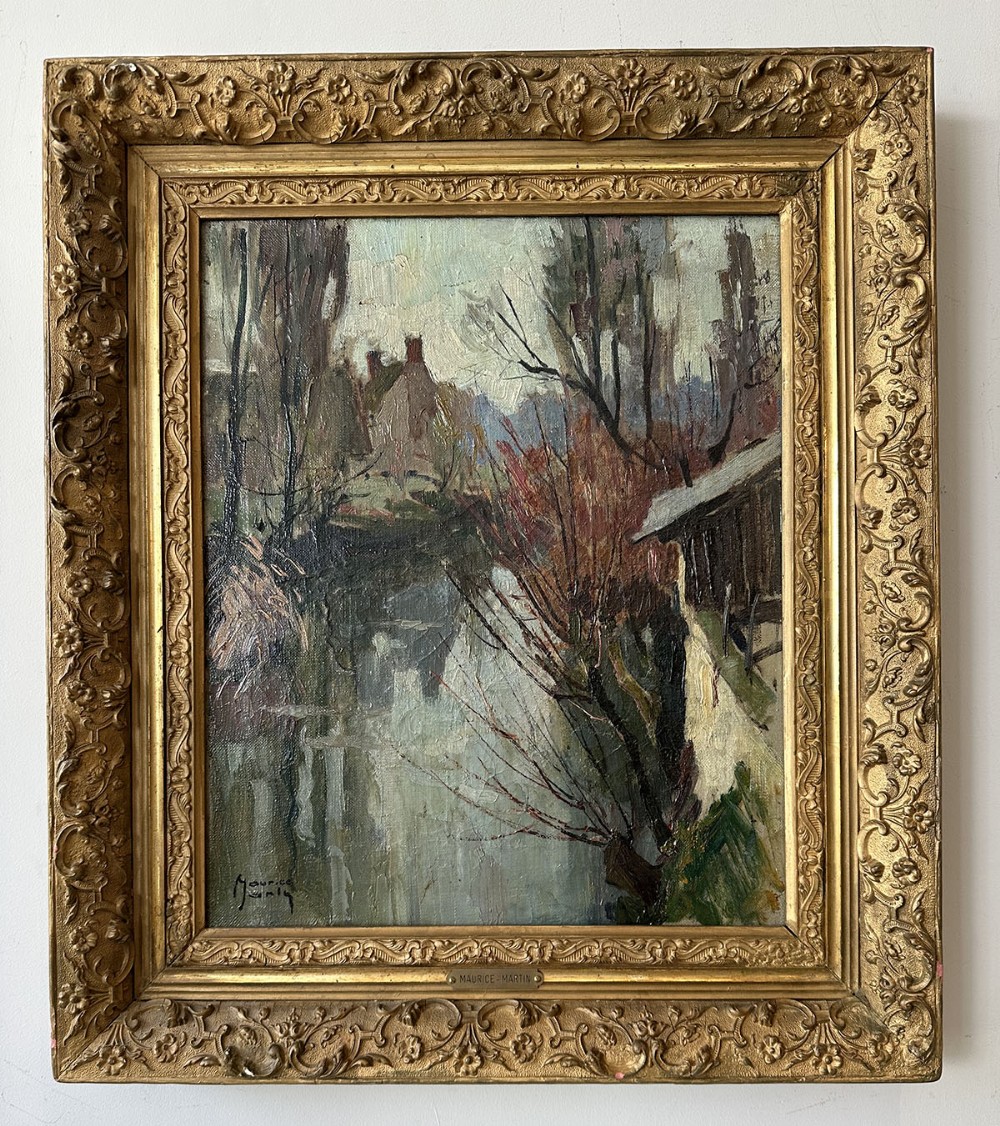
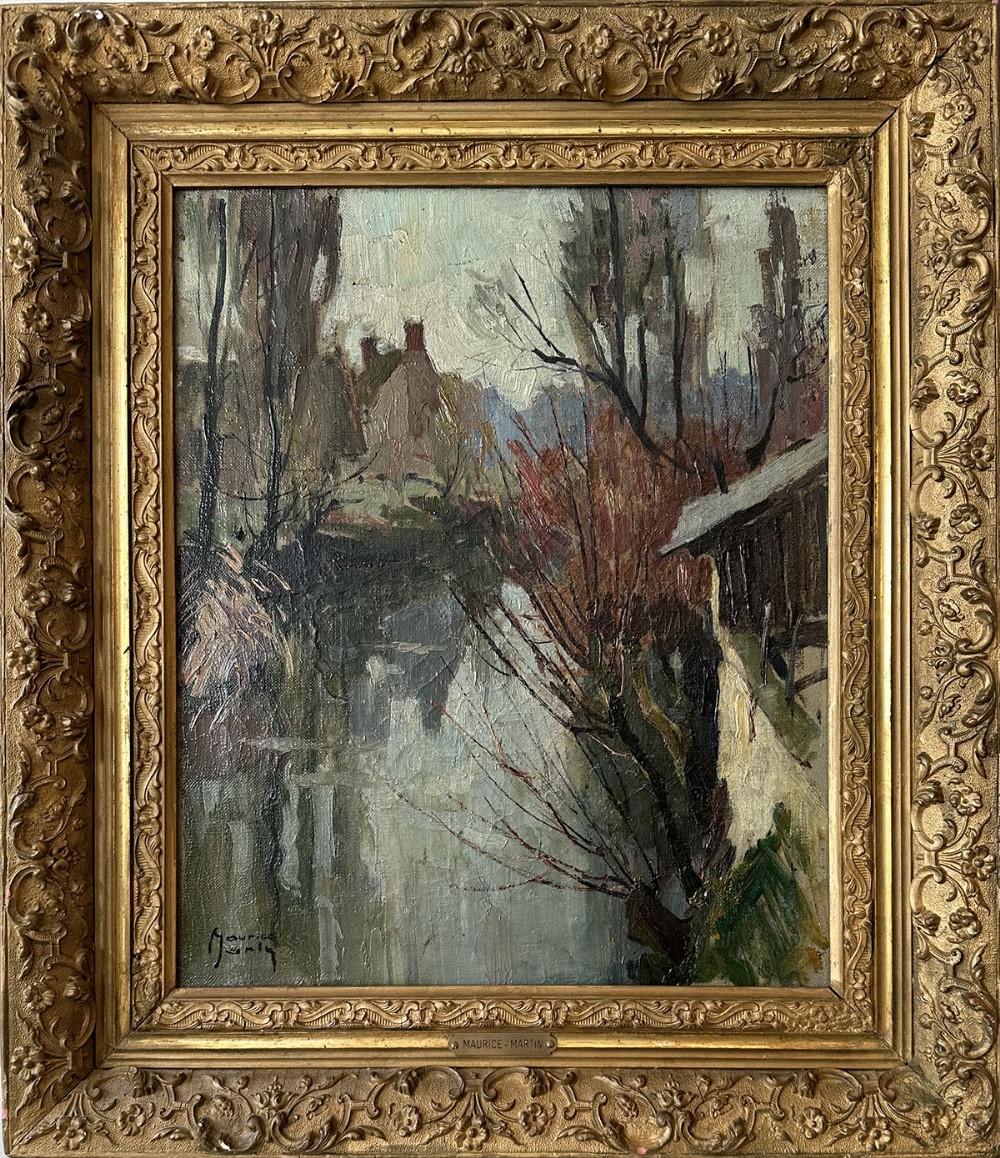
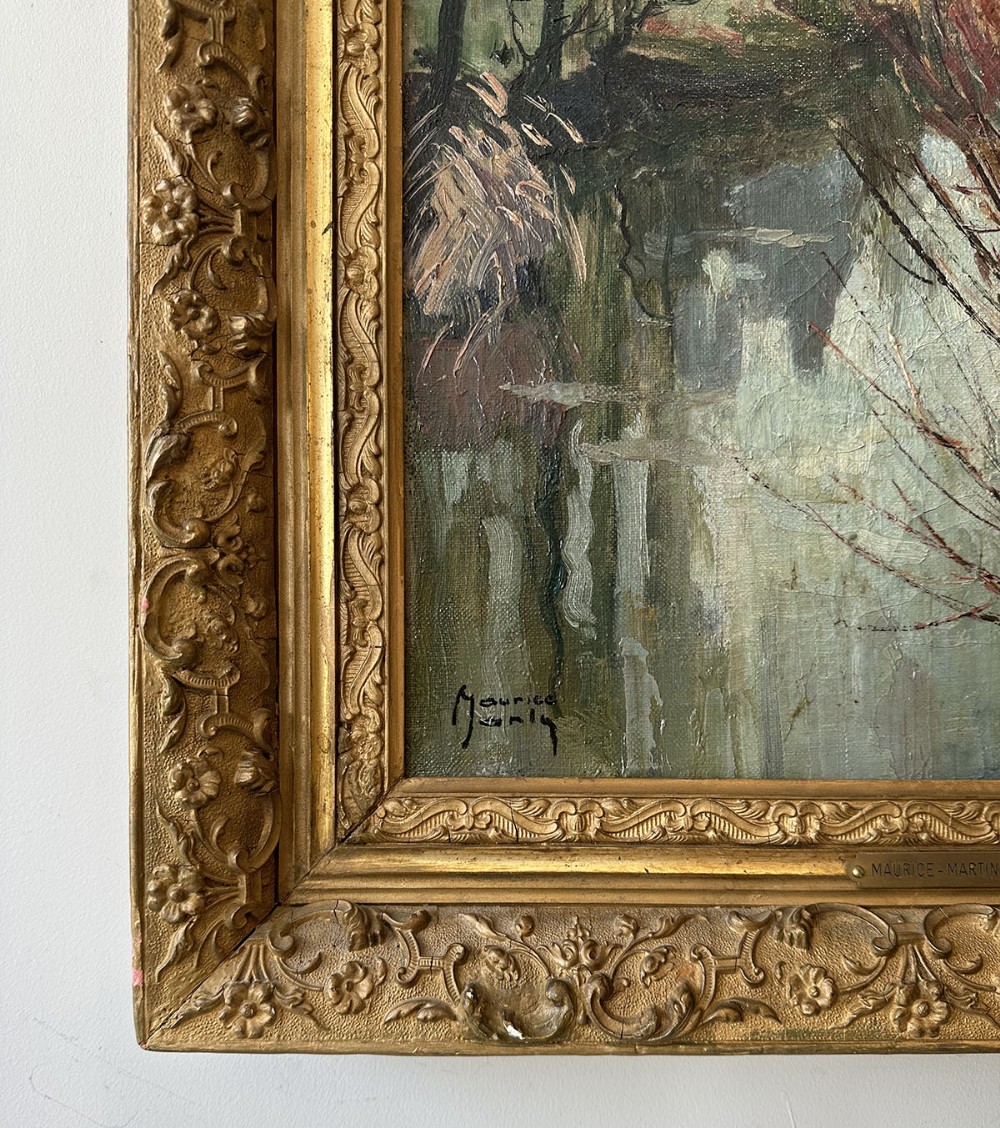
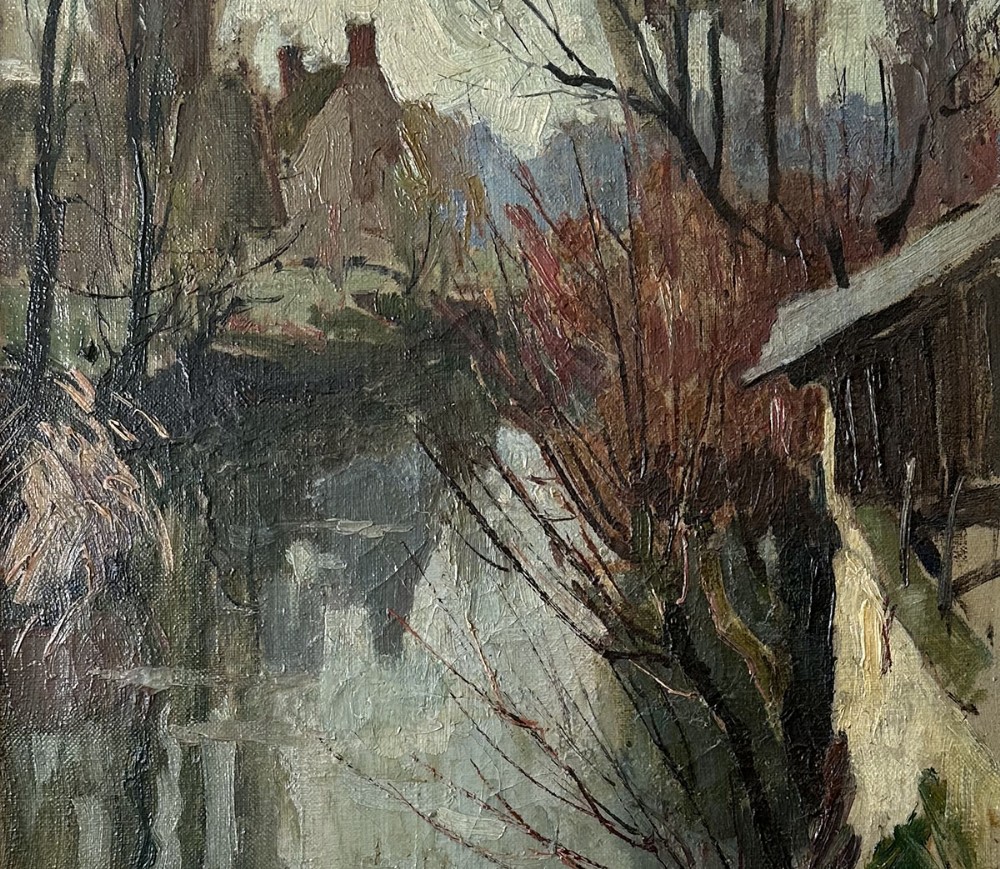
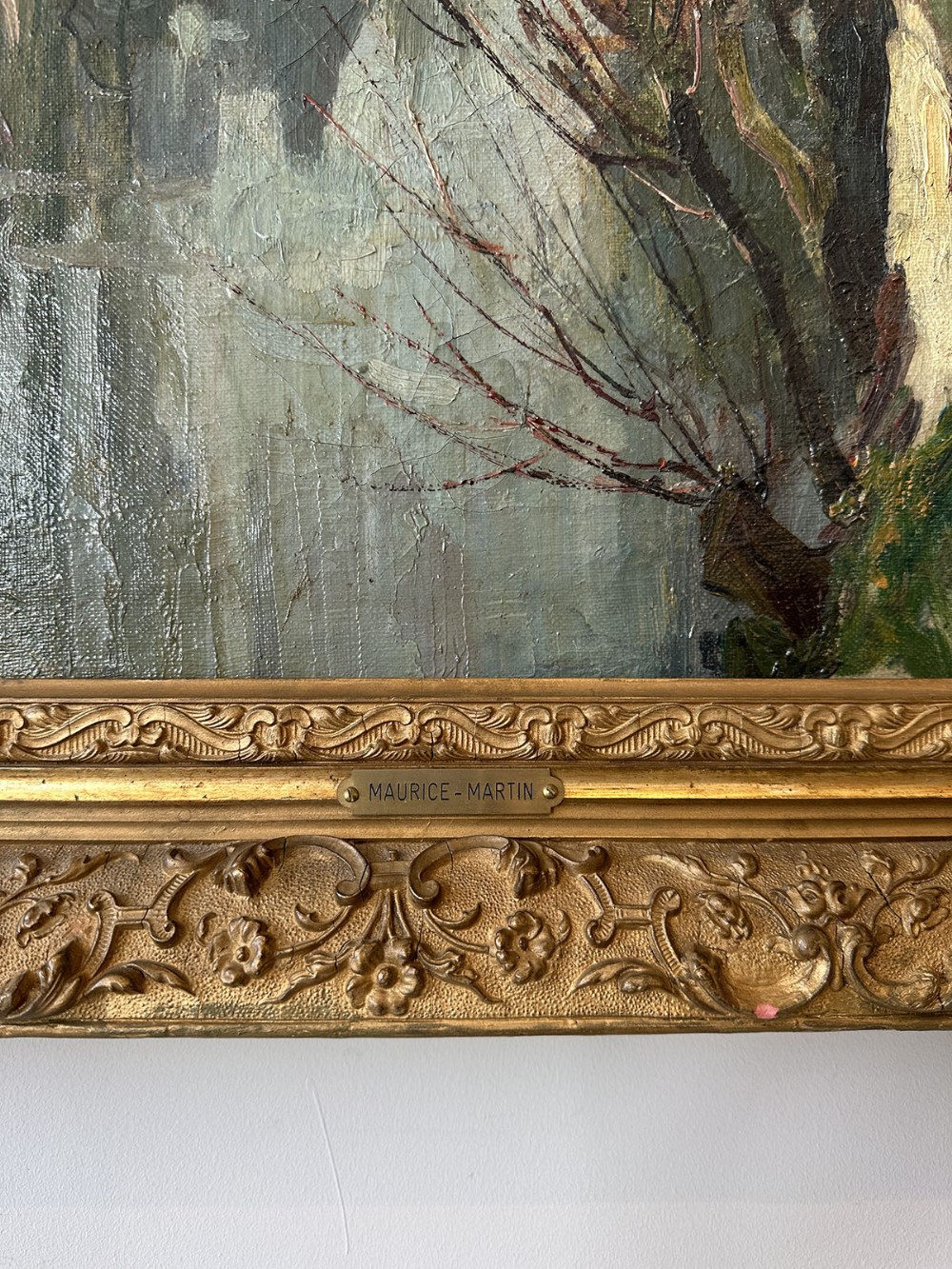
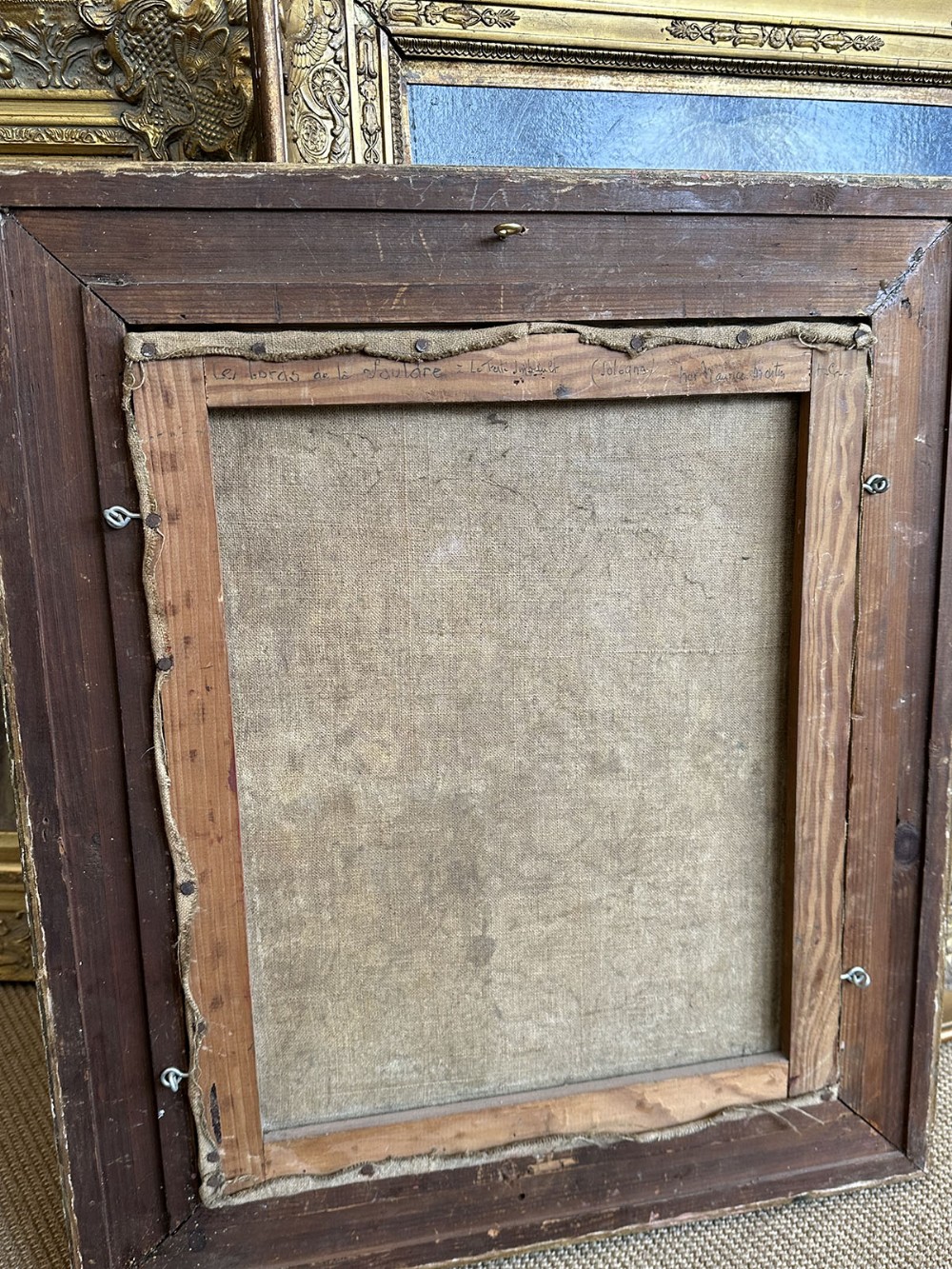
Rue des Fontenelles has dated this piece to the 1930s.
Maurice Martin (1894-1978) was born at Mormant in the Île-de-France region of north-central France.
Encouraged by a strong passion for landscape painting, Martin travelled to Moret sur Loing, not far from the more famous Barbizon region. There he became close friends with Henry Moret and his school of Impressionist painters, who lived and worked close to this picturesque town in central France, and who were themselves profoundly influenced by the innovative creativity of the four leading lights of Impressionism: Claude Monet, Pierre-Auguste Renoir, Camille Pissarro and Alfred Sisley. Martin was encouraged to practice ‘en plein air’ painting and the use of pure colour, believing that this technique was the only way to capture the immediacy of the outdoor scenery.
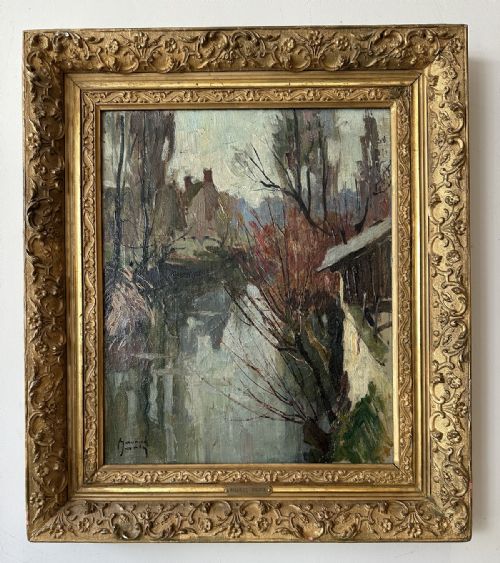
Martin uses a free and generous style of painting in order to catch the rapid changes in outdoor light. He attempted to extract the colours and shapes as well as the fragrances of nature, putting the total ambiance and experience directly onto the canvas. As a general rule, artists from prior schools of classical training chose to absorb the experience of nature into mental and emotional images or perhaps even sketches and then return to the silent studio where they organized their thoughts and interpreted them onto canvas. Martin’s ethos was the complete opposite. The primary motivation for Martin, born out of the teachings of the Moret School, was to go through the woods with his paints and canvasses capturing a piece of nature at an exact prescribed time, thus eliminating the intellectual character of landscape painting. He believed that a landscape should be viewed purely as a moment of beauty.
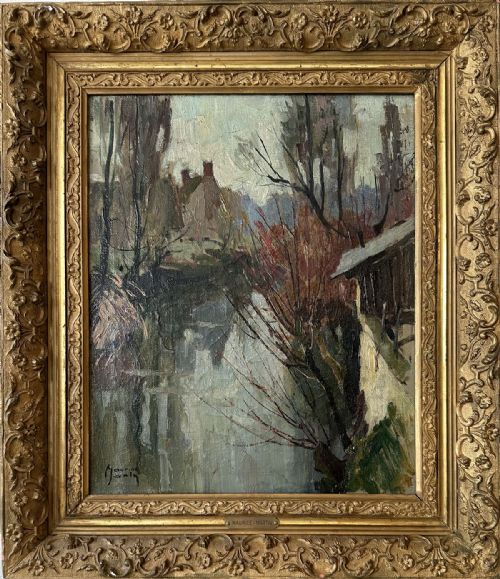
His many landscapes include studies of Picardy, the Île-de-France, Brittany and Provence. He also painted in Spain, particularly in Grenada and Malaga, capturing with the tip of his brush the dances of sunlight he so much loved.
Martin exhibited at all the major exhibitions in France, and received many awards. In 1941 he was elected as a member of the Jury at the Salon d’Hiver. One of his highest achievements was winning the Gold Medal of the Paris Salon in 1946, as well as the Corot Prize. He was Vice-President of the Salon d’Hiver and in 1957 was elected Vice-President of the Paris Salon.
Several of his paintings have been acquired by the City of Paris and the French Government, as well as by museums and Public Galleries in Morocco and France, namely the Gallery Beaux Arts of Morocco, the Ministry of Anciens Combattants, Gallery of the Île-de-France and the Gallery of French Overseas.Maurice Martin was born on July 19, 1894 in Mormant, where he spent his entire childhood. A gifted schoolboy, he spends his free time drawing. His father made him work in the family house painting business. The family then moved to Paris around 1910 and the young painter continued to work in his father's business until 1914, regretting not being able to study at the Beaux Arts.
Called to Lisieux in August 1914 for military preparation, he left for the front three months later, assigned to the 149th line infantry regiment. Wounded in the left arm, he was cited three times in the order of the regiment and its army corps in Verdun. Hospitalized in Lyon, he spent his convalescence painting and drawing. In 1917 he returned to the regiment in Lisieux, a city where he painted the old streets and the Rue aux fèves in particular.
From 1919 to 1922, he created his own business in the disaster areas then in 1922, he retu
Rue des Fontenelles has dated this piece to the 1930s.
Specialists in french antiiques, decorative objects and french and european paintings.
You can view the stock and full dealer information on the Rue des Fontenelles Profile Page
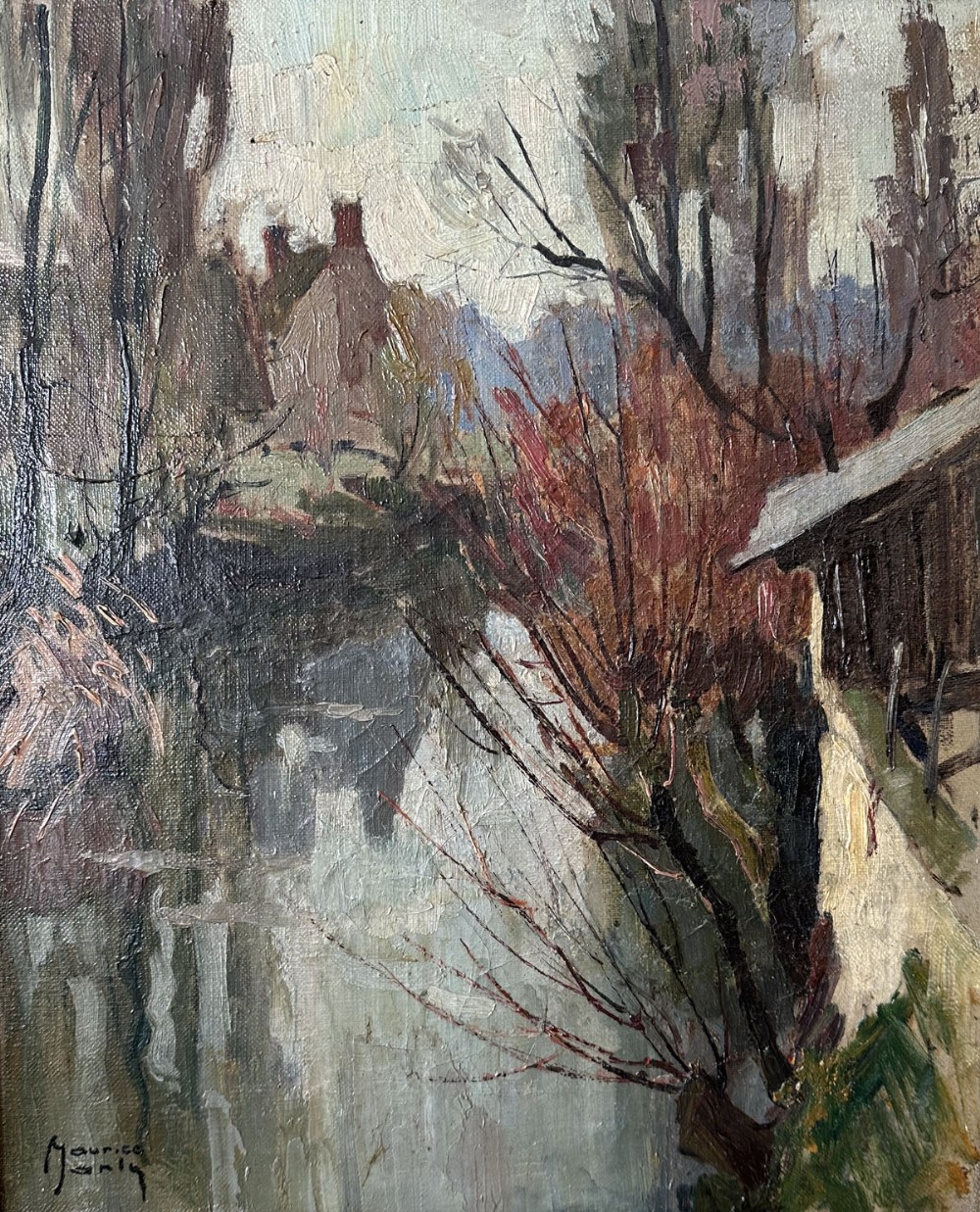
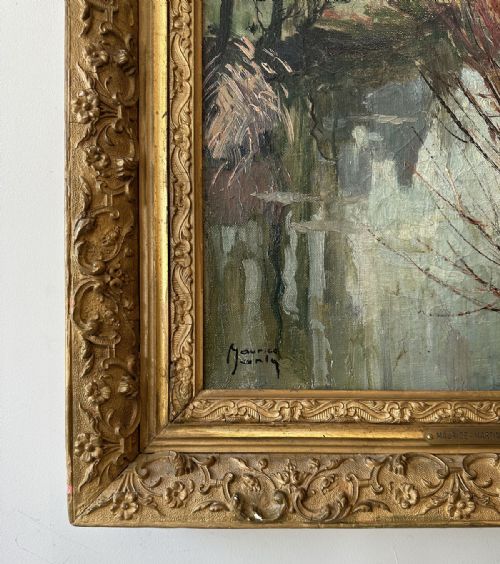
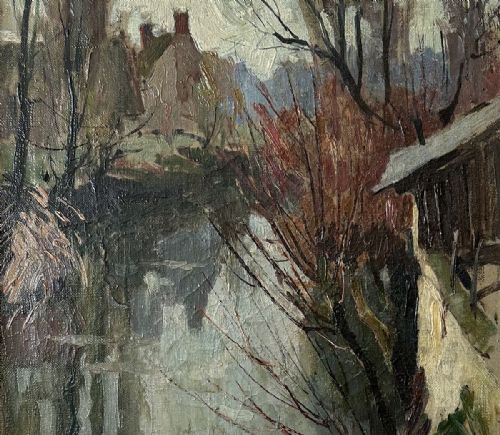
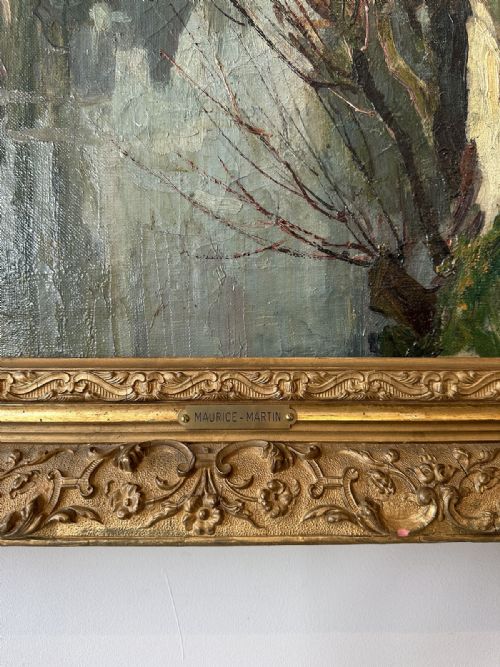
View of a River - Antique Oil Painting