
Roy Precious - Antiques & Fine Art has dated this piece to the 17th Century.
The canvas is a coarse weave, often used by the artist.
'Osnabrug' was a coarse cloth of linen or hemp, manufactured in Osnabruck in Germany.

MARY BEALE (1633-1699) was born in Barrow, Suffolk, the daughter of John Cradock, a Puritan rector. Her mother, Dorothy, died when she was 10. Her father was an amateur painter, and member of the Painter-Stainers' Company, and she was acquainted with local artists, such as Nathaniel Thach, Matthew Snelling, Robert Walker and Peter Lely. In 1652, at the age of 18, she married Charles Beale, a cloth merchant from London - also an amateur painter.

She became a semi-professional portrait painter in the 1650s and 1660s, working from her home, first in Covent Garden and later in Fleet Street. Mary Beale was not the only female painter in England, but her name has survived as that of the only woman to make a successful living, and to enjoy a flourishing practice as a portraitist.

She became reacquainted with Sir Peter Lely, now Court Artist to Charles II. Her later work is heavily influenced by Lely, being mainly small portraits. He was Beale’s strongest artistic supporter. The friendship between Lely and Mary Beale enabled her, famously, to observe the master in the act of painting – a remarkable privilege – in order to study his technique. It is perhaps not surprising, therefore, that many of her portraits have been misattributed to Lely or his Studio .She was widely reckoned to be Van Dyck's most accomplished copyist. Her grasp of Lely's colouring is evident, but the pleasant and direct manner in which she treats her sitters is entirely her own.
Beale was also a talented and intelligent writer, completing her ‘Discourse on Friendship’ [British Library] in 1667, in which she discusses friendship. Mary and her husband believed strongly in equality between man and wife, as shown by Mary’s ‘Essay on Friendship’. Without such equality, Mary believed, true friendship could not exist; ‘This being the perfection of friendship that it supposes its professors equal, laying aside all distance, & so levelling the ground, that neither hath therein the advantage of other.’
SIZE: 34 x 28.5 x 1.75 inches including the frame.
PROVENANCE: Hillsleigh, The Hill, Burford, Oxfordshire.
Roy Precious - Antiques & Fine Art has dated this piece to the 17th Century.
Roy and nadine precious: specialists in portraiture from the 16th to the 20th century. Established in 1972.
You can view the stock and full dealer information on the Roy Precious - Antiques & Fine Art Profile Page
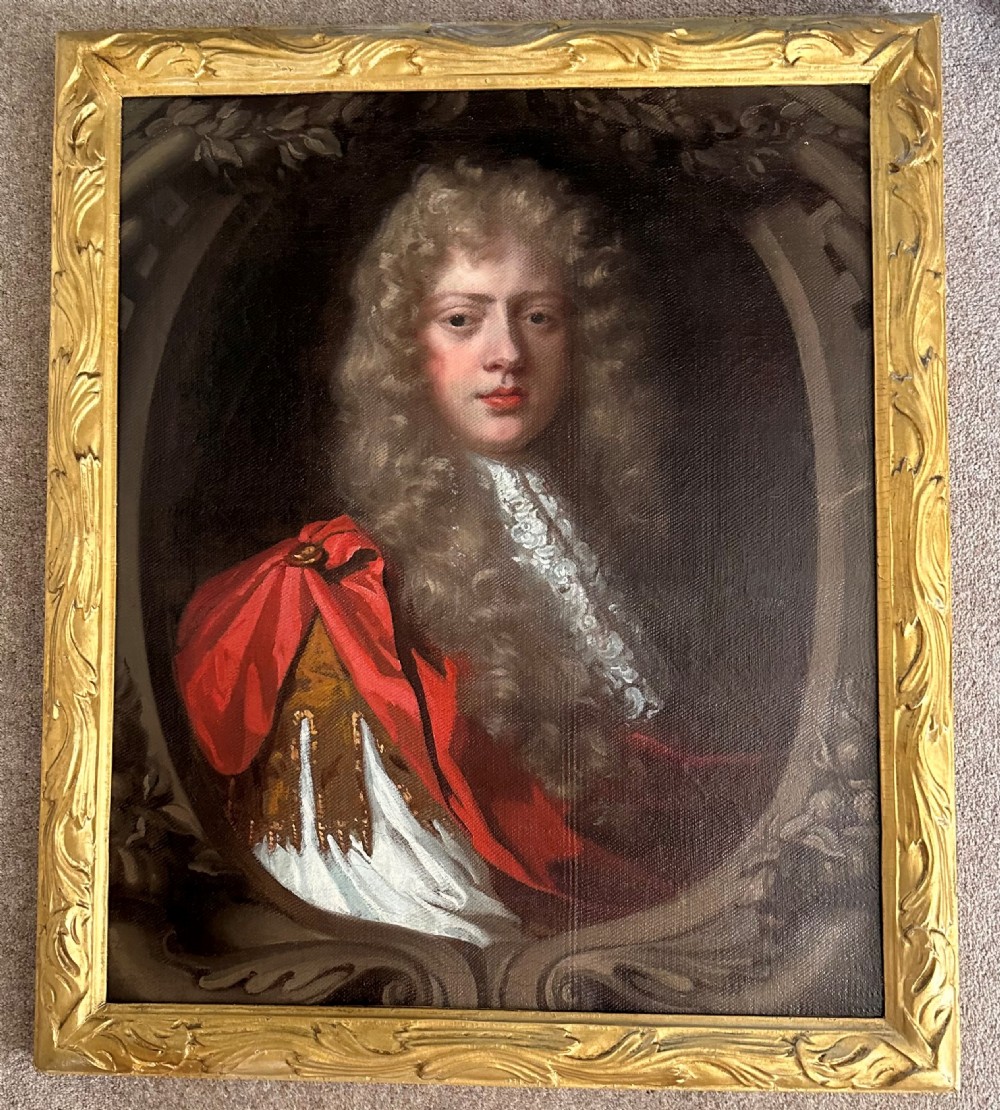

Portrait of a Gentleman C.1680, by Mary Beale.


